EN
EN


Ingredients
- What is VATS (Video-Assisted Thoracoscopic Surgery)?
- How is VATS Closed Lung Surgery Performed?
- Surgical Process and Technological Equipment Used
- Single Incision (Uniportal) VATS and Multiple Incision Methods
- Which Diseases Is VATS Used To Treat?
- The Role of VATS in Lung Cancer Surgery
- Lung Collapse (Pneumothorax) and VATS Intervention
- Diagnostic Lung Biopsy
- What are the Advantages of VATS Closed Surgery?
- Who is Suitable for VATS Surgery?
- Preoperative Evaluation and Examinations
- Differences Between Robotic Surgery and VATS
- Recovery Process After VATS Surgery
- Length of Hospital Stay and Return to Normal Life
- Home Care and Considerations
- Frequently Asked Questions
- What is video-assisted thoracoscopic surgery?
- How many hours does VATS surgery take?
- Why is VATS surgery performed?
- How is VATS biopsy performed?
- Scientific Bibliography
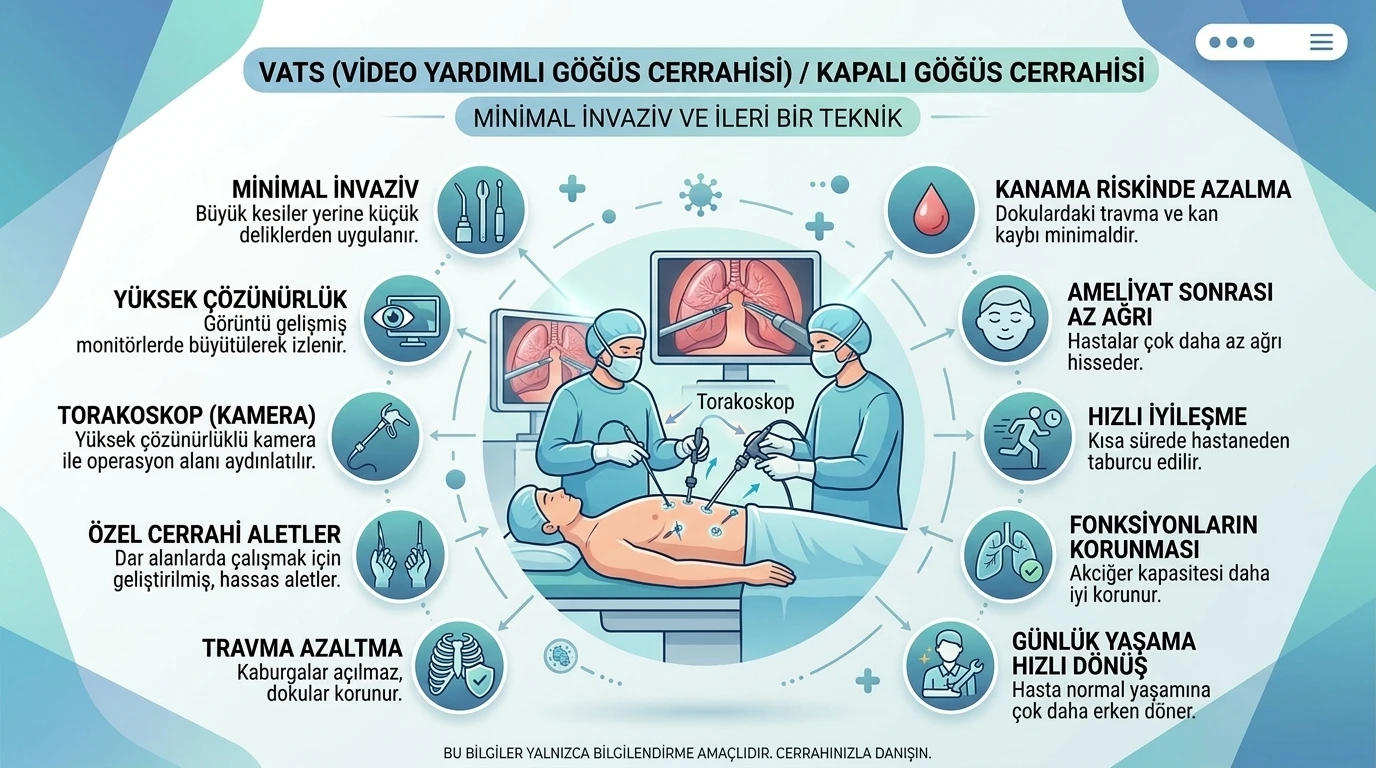
VATS (Video-Assisted Thoracic Surgery) is an advanced surgical method that allows rib cage surgeries to be performed with a minimally invasive approach, i.e., a closed technique, instead of the traditional open method.
In this procedure, instead of making large incisions in the chest wall, the surgeon inserts a high-resolution camera (thoracoscope) and specialized surgical instruments through one or several small holes and monitors the operation through advanced monitors.
This technology, which does not require opening the ribs, minimizes trauma during the operation and reduces the risk of bleeding, while allowing patients to feel much less pain in the postoperative period and return to their normal daily lives much faster.
What is VATS (Video-Assisted Thoracoscopic Surgery)?
Video-Assisted Thoracoscopic Surgery, or VATS for short, is the minimally invasive, i.e. closed technique, in which rib cage surgeries are performed instead of the traditional open method.
Thanks to the developments in medical technology, operations are now carried out with the help of a camera entered through small holes instead of large incisions in lung surgery.
Considered the gold standard in modern thoracic surgery, this method provides the surgeon with a high-resolution field of view while preserving the patient’s body integrity.
VATS is a great revolution both aesthetically and functionally as it is performed without the need to cut the muscles in the chest wall.
How is VATS Closed Lung Surgery Performed?
VATS operation is performed under general anesthesia and usually in the position where the patient lies on his side.
The surgeon creates small incisions (ports) on the rib cage, ranging in size from 1 to 3 centimeters.
A high-resolution thoracoscope (camera) is inserted through one of these small incisions.
Images from the camera are projected in high resolution on monitors in the operating room.
The surgeon completes the surgery by following it on this screen with special surgical instruments inserted through other small holes.
Surgical Process and Technological Equipment Used
The cameras used during the surgery magnify the tissues much more than they can be seen with the naked eye and present them to the surgeon.
This gives the surgeon a great advantage in protecting nerves and vital vessels.
Specially developed suture sealers called staplers are used to seal the lung tissue tightly.
There is no need to expand the rib cage (use a retractor) during the whole process.
Single Incision (Uniportal) VATS and Multiple Incision Methods
While the traditional VATS method usually uses three small incisions, today the entire operation can be performed through a single small incision with the Uniportal VATS technique.
This approach minimizes surgical trauma, further reducing the patient’s postoperative pain sensation.
Based on the case and the location of the tumor, the surgeon decides which method is safest for the patient.
Prof. Dr. Levent Alpay: “Quitting smoking in the preoperative period is the most critical step for preserving lung capacity and rapid recovery after surgery.
The breathing exercises you will do during the preparation process for the surgery will directly affect the time you can stand up after the operation.”
Which Diseases Is VATS Used To Treat?
The VATS method is widely preferred both in the diagnosis phase and in therapeutic operations.
It offers unparalleled comfort, especially in early-stage tumors and in the examination of masses of unknown cause.
The Role of VATS in Lung Cancer Surgery
In the surgical treatment of lung cancer, lobectomy (removal of one lobe of the lung) can be performed safely with VATS.
Cleaning (dissection) of the lymph nodes is performed meticulously with this closed method, as in open surgery.
Lung Collapse (Pneumothorax) and VATS Intervention
In recurrent lung collapse, VATS is the most effective way to close the air sacs (bullae) on the lung surface.
The patient is usually able to be discharged within 1-2 days after this procedure.
Diagnostic Lung Biopsy
Biopsy with VATS to obtain a definitive tissue diagnosis from masses that cannot be reached by other methods brings the diagnostic success closer to 100%.
This short procedure plays a critical role in determining the patient’s treatment roadmap.
What are the Advantages of VATS Closed Surgery?
We can summarize the main privileges offered by the VATS method in terms of the comfort and medical benefits it provides to the patient as follows:
- Minimal Trauma: Since it is applied without opening between the ribs and without cutting large muscle groups, body integrity is preserved.
- Mild Pain Process: Since there is no large surgical incision, the postoperative pain level is minimal and the need for painkillers is low.
- Rapid Mobilization: Patients can usually stand up a few hours after surgery and meet their personal needs on their own.
- Short Recovery Time: Compared to traditional open surgery, the hospital stay is shortened and the return to social and business life is much faster.
- Low Risk of Complications: The small incision site significantly reduces the risk of infection and bleeding.
- Aesthetic Advantage: Small hole scars left in the rib cage become indistinct over time and do not disturb the patient cosmetically.
- Strong Immunity: The low surgical stress helps to suppress the patient’s immune system less.
Surgical Method Comparison Table
| Feature | Traditional Open Surgery (Thoracotomy) | VATS (Closed Surgery) |
| Incision Size | 15 – 20 cm | 1 – 4 cm (Single or multiple) |
| Separation of the Ribs | Yes (Retractor is used) | No (Work through the incision) |
| Length of Hospital Stay | 7 – 10 Days | 2 – 4 Days |
| Recovery Time | 4 – 6 Weeks | 1 – 2 Weeks |
| Postoperative Pain | Severe (Neuralgia risk) | Light – Medium |
Who is Suitable for VATS Surgery?
It is the primary choice in stages where the tumor has not yet spread and is not excessively attached to surrounding tissues.
It is ideal in the treatment of benign formations that are detected in the lung and need to be surgically removed.
It is generally suitable for masses below 6-7 centimeters and large enough to be managed with closed surgical instruments.
· It is the most comfortable method for patients who need tissue samples (biopsy) from nodules of unknown cause.
It is applied to individuals who have recurrent lung collapse problems and need to close the air sacs on the lung surface.
· In preoperative tests, it is suitable for patients with respiratory capacity who can tolerate the surgical process with one lung.
Patients who do not have severe adhesions in the chest cavity are primary candidates for the VATS technique.
Preoperative Evaluation and Examinations
The patient’s pulmonary function tests, heart capacity and the proximity of the tumor to the vessels are examined in detail.
Computed tomography and PET-CT results are determining factors in the choice of surgical technique.
Differences Between Robotic Surgery and VATS
In robotic surgery, the surgeon manages the robot arms through a console, while in VATS, he directs the instruments directly with his own hands.
While both methods are minimally invasive, VATS’s cost-effectiveness and tactile feedback make it a preferred choice in some cases.
Prof. Dr. Levent Alpay: “Rather than which method to choose, our priority is to completely remove the tumor in accordance with oncological principles. Closed surgery is a means of comfort provided without sacrificing oncological success.”
Recovery Process After VATS Surgery
The healing process varies depending on the patient’s general condition and whether there are additional diseases.
However, in general, patients who undergo closed surgery are discharged much earlier than open surgery.
Length of Hospital Stay and Return to Normal Life
After VATS lobectomy, patients can usually be sent home on the 3rd or 4th day with their drains removed.
It is recommended to take light walks and continue deep breathing exercises for the first week at home.
Home Care and Considerations
Cleaning the incision sites and regular use of medications prescribed by your doctor will speed up healing.
Avoiding excessively strenuous activities for the first 15 days allows the lungs to open at full capacity.
Clinical Experiences and Anonymous Case Examples
In the applications carried out in our clinic, the positive effect of modern techniques on patient morale is clearly observed.
Case A: Uniportal VATS technique was applied in a 62-year-old patient with early-stage lung nodule. The patient was discharged on the 2nd postoperative day and returned to office work on the 10th day.
Case B: In our 24-year-old young patient who presented with the complaint of recurrent lung collapse (pneumothorax), bullectomy was performed with VATS. The patient’s return to sports life was 3 times faster than open surgery.
You can contact our expert team to get detailed information about closed surgery options and the VATS method for your lung health.
You can make an appointment at our clinic to learn about our personalized treatment processes.
Frequently Asked Questions
What is video-assisted thoracoscopic surgery?
It is a closed surgery method performed by watching the rib cage on a monitor with the help of a camera and special surgical instruments inserted through small holes, without making a large incision.
How many hours does VATS surgery take?
Although it varies according to the scope of the procedure to be performed, simple biopsy procedures are completed in about 30-60 minutes, and comprehensive operations such as removal of the lung lobe are usually completed in 1.5 to 3 hours.
Why is VATS surgery performed?
It is applied for both therapeutic and diagnostic procedures such as lung cancer treatment, lung collapse (pneumothorax) repair, drainage of fluids in the chest cavity and definitive diagnosis of suspicious masses.
How is VATS biopsy performed?
Under general anesthesia, a camera is inserted through one or two small incisions made in the chest wall, and the suspicious tissue piece is safely removed with surgical instruments and sent for pathological examination.
Scientific Bibliography
- PubMed: Evolution of VATS lobectomy
- The Lancet Oncology: VATS vs open lobectomy for lung cancer
- Journal of Thoracic Disease: Uniportal VATS: evidence and technical challenges