EN
EN



Ingredients
- What is Robotic Surgery (RATS)?
- Lung Surgery with Da Vinci Robotic System
- Main Differences Between RATS and VATS
- In Which Chest Diseases Is Robotic Surgery Used?
- Advantages of Robotic Method in Lung Surgery
- How is Robotic Lung Surgery Performed?
- Preoperative Preparation and Planning Process
- Surgeon’s Intervention via Robotic Console
- Robotic Instruments Used During Surgery
- Recovery and Follow-up After RATS Surgery
- Length of Hospital Stay and Pain Management
- Return to Daily Life and Business Life
- Frequently Asked Questions
- Is there robotic surgery in public hospitals?
- In which surgeries is robotic surgery used?
- Does SSI cover robotic surgery?
In today’s modern medicine, surgical interventions have evolved into minimally invasive methods that aim to preserve the patient’s body integrity at the highest level.
Robotic-Assisted Thoracic Surgery (RATS) is the performance of operations in the rib cage through high-tech robotic systems.
This method stands out for the unmatched precision it offers to the surgeon, especially in the treatment of lung cancer and complex chest cavity tumors.
Unlike traditional open surgery, these procedures, which are performed without the need to open between the ribs, radically change the healing process.
What is Robotic Surgery (RATS)?
Robotic surgery is a closed surgery technique in which the surgeon directs the robotic arms with high precision from a console head.
The system reduces the surgeon’s hand movements on a millimeter scale and transfers them to the operation area and provides mobility at angles that the human hand cannot reach.
RATS is not just a technology but a hybrid treatment discipline that combines the surgeon’s expertise with a technological vision.
Lung Surgery with Da Vinci Robotic System
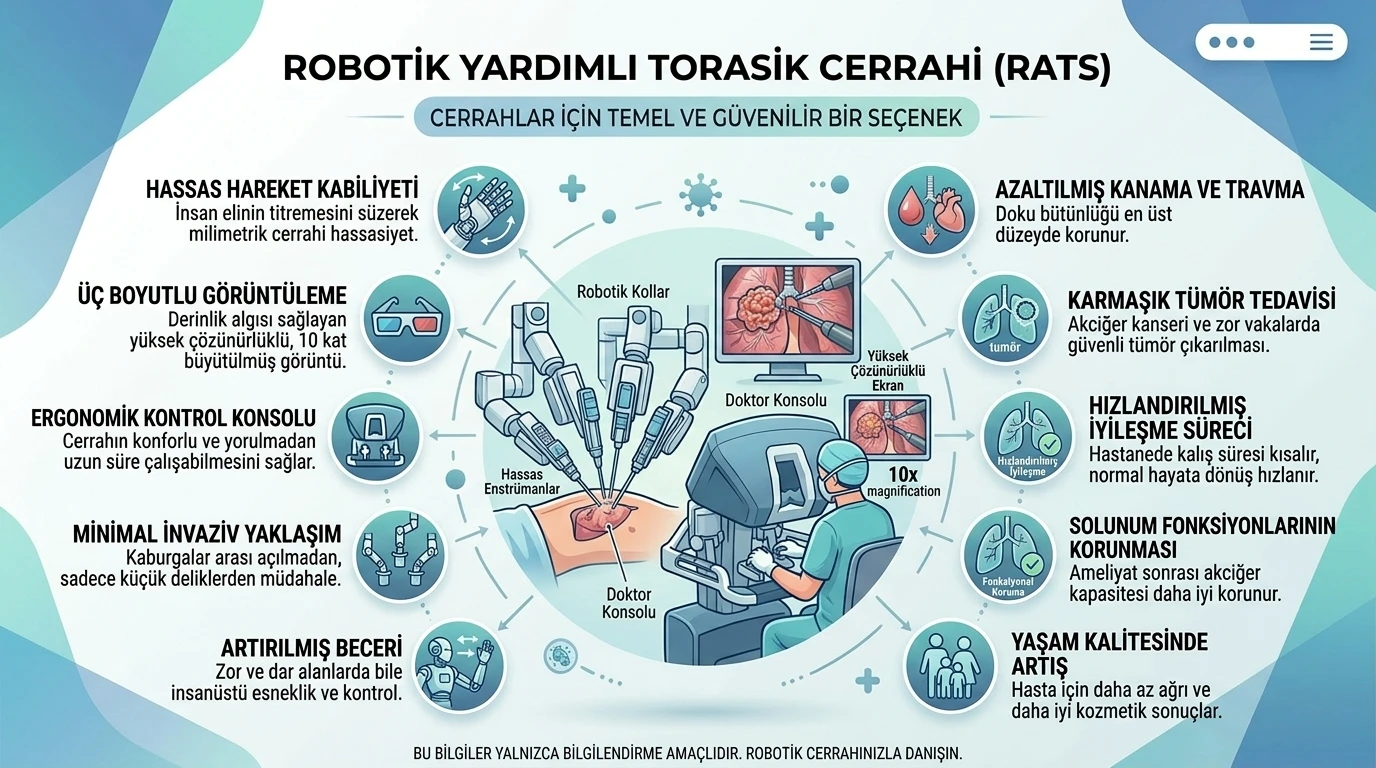
The da Vinci surgical system consists of a high-resolution three-dimensional camera and surgical arms with multi-axis motion capability.
The surgeon can meticulously protect the vascular and nerve structures by seeing the operation area magnified 10-15 times and with preserved depth perception.
Thanks to this system, interventions in narrow and deep areas such as the rib cage become much safer.
Main Differences Between RATS and VATS
VATS (video-assisted surgery) uses two-dimensional imaging and flat instruments, while RATS offers three-dimensional depth perception and wrist instruments that can rotate 540 degrees.
In the VATS method, the surgeon works by looking at the monitor, while in the RATS method, the surgeon focuses entirely on the operation area in the console.
This technological difference puts the robotic method one step ahead, especially in stages that require millimeter precision, such as lymph node dissection.
Prof. Dr. Levent Alpay: “Robotic surgery is one of the greatest opportunities that technology offers to the surgeon, but it should not be forgotten that it is not the robot that performs the surgery, but the experience of the surgeon who manages that system. Questioning your surgeon’s experience and case history in this technology is the key to success, as well as focusing on the method in the treatment decision.”
In Which Chest Diseases Is Robotic Surgery Used?
Robotic surgery (RATS) is preferred in the treatment of many chest diseases thanks to its high mobility in narrow and hard-to-reach areas of the rib cage:
Lung Cancer: It is the gold standard in removal of the lung lobe or segment (lobectomy/segmentectomy) in early and mid-stage tumors.
Thymoma and Mediastinum Tumors: It provides millimeter precision removal of masses located between the two lungs, very close to the heart and main vessels.
Myasthenia Gravis: It is used in thymus gland removal (thymectomy) surgeries, which can cause this neurological disease.
Diaphragm Surgery: Offers high suture precision in repairing diaphragmatic paralysis or hernias.
Esophageal (Esophageal) Diseases: It is preferred in the surgical treatment of esophageal cancer or benign tumors.
· Chest Wall Tumors: It allows the removal of masses located close to the rib or rib cage bones without damaging the surrounding tissues.
Advantages of Robotic Method in Lung Surgery
The advantages of robotic surgery for the patient and the surgeon play a direct role in the improvement of clinical outcomes.
The minimally invasive approach reduces surgical trauma while preventing compromise in oncological discipline.
- High Precision: The 7-stage movement capability of the robotic arms allows even the most complex stitches to be easily made in tight spaces.
- Three-Dimensional Image: Having depth perception makes it easier to understand the true distances of tissues and protect vital organs.
- Less Blood Loss: Thanks to the small incisions and precise tissue dissection, blood loss during surgery is very low.
- Rapid Functional Recovery: Thanks to the preservation of lung capacity and less pain, patients are mobilized much earlier.
Treatment Methods Comparison Table
| Feature | Open Surgeon (Thoracotomy) | VATS (Off) | RATS (Robotics) |
| Image Quality | Naked Eye (2D) | Monitor (2D) | Console (3DHD) |
| Instrument Capability | Limited | Flat / Restricted | 540° Wrist Movement |
| Flicker Suppression | None | None | Electronic Filtration |
| Pain Level | High | Low | Very Low |
| Oncological Opinion | Good | Medium | Excellent |
How is Robotic Lung Surgery Performed?
The robotic surgery process requires high standards of operating room equipment and a trained team.
The procedure is carried out through 3 or 4 small holes, usually 1 centimeter, drilled in the patient’s body.
Preoperative Preparation and Planning Process
Before the surgery, the patient’s heart and lung reserves are evaluated in detail with PET-CT and pulmonary function tests.
Based on the location of the tumor, the port entry points where the robotic arms will be placed are planned specifically for each patient.
Surgeon’s Intervention via Robotic Console
The surgeon sits at a special control console in the operating room, not at the robot next to the patient.
The surgeon’s hand and finger movements are instantly detected by the system and transmitted to the robotic arms in the rib cage.
At every stage of the operation, the control is 100% in the hands of the surgeon; The robot does not make any movements on its own.
Robotic Instruments Used During Surgery
Tips designed to hold, cut, burn or suture tissues can be quickly changed during surgery according to the surgeon’s preference.
These instruments also have technologies (in some models) that make the surgeon feel the tissue resistance.
Who are the Suitable Candidates for Robotic Surgery?
Robotic surgery is a reliable option for most lung patients who are oncologically suitable for surgery.
However, the choice of method is determined by individual risk factors and the stage of the disease.
- Early and Intermediate Stage Patients: In stages 1 and 2 of lung cancer, the robotic method has become the primary recommendation.
- Elderly or Comorbidities: The low surgical trauma allows these patients to get through the process more easily.
- Difficult-Location Tumors: The sensitivity of the robot is preferred for tumors close to the vessels or in the upper parts of the rib cage.
Recovery and Follow-up After RATS Surgery
The greatest success of robotic surgery is that it can quickly return the patient to his social life rather than the hospital.
In the first hours after the operation, breathing exercises are started as soon as the patient becomes conscious.
Length of Hospital Stay and Pain Management
Patients who undergo robotic surgery usually stay in the hospital half less often than open surgery (2-4 days on average).
Pain management is much more comfortable as the nerve endings are not compressed and the ribs are not stretched.
Return to Daily Life and Business Life
Most patients switch to light walks and a normal diet within a week after discharge.
It is possible to return to office work within 10-15 days, provided that heavy physical activities are avoided.
Clinical Experiences and Anonymous Case Examples
In our clinical practices, we see that robotic surgery provides vital convenience, especially in high-risk patients.
Case Example 1: A 70-year-old patient diagnosed with coronary artery disease and COPD had a tumor in the right upper lobe.
This patient, who may have difficulty in removing traditional open surgery, was operated on with the robotic method.
Our patient, who went home on foot on the 3rd day after the operation, did not develop any respiratory complications.
Case Example 2: A robotic system was used in a young patient with a mass in the mediastinum region, millimeters from the main vessels.
Thanks to the anti-tremor feature of the robot, the mass was removed in one piece by preserving the vessels and the patient was discharged on the 2nd day.
For more information about robotic lung surgery and personalized treatment options, you can seek expert opinion.
You can contact us for RATS applications and the appointment process performed in our clinic.
Frequently Asked Questions
Is there robotic surgery in public hospitals?
Robotic surgery systems are available in certain full-fledged city hospitals and university hospitals in Turkey, but this opportunity is not available in every state hospital.
In which surgeries is robotic surgery used?
In thoracic surgery, especially lung cancer and thymoma surgeries; It is widely preferred in many operations in the fields of urology, gynecology, general surgery and cardiac surgery.
Does SSI cover robotic surgery?
SSI covers some of the robotic operations in state and university hospitals if certain medical criteria are met; However, the process and additional pricing may differ in private hospitals.
Scientific Bibliography
- PubMed: Robotic vs. VATS lobectomy: long-term outcomes
- Journal of Thoracic Disease: Robotic assisted thoracic surgery (RATS) – the state of art
- The Annals of Thoracic Surgery: National trends and outcomes in robotic lung resection