EN
EN


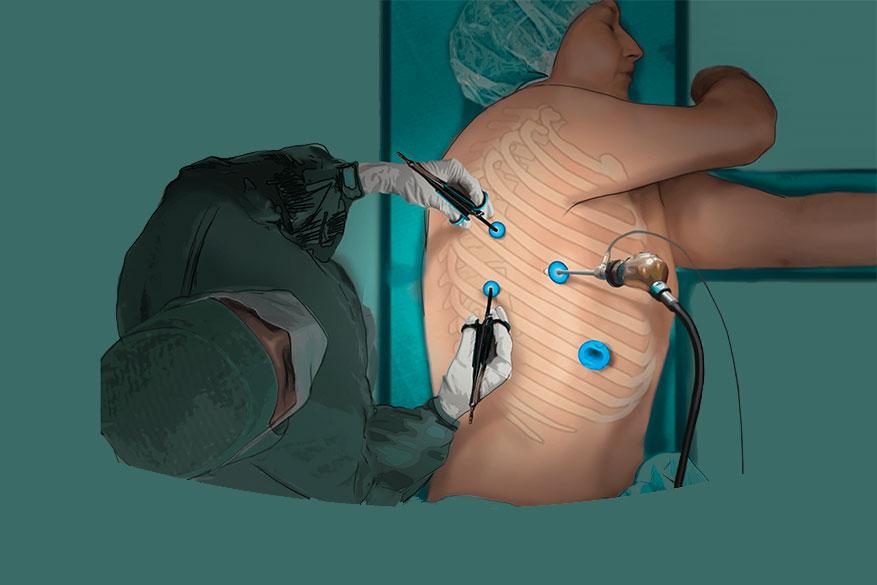
VATS (Video-Assisted Thoracoscopic Surgery), one of the most important links of technological transformation in lung surgery, has largely replaced traditional open surgeries.
This method allows the operation to be completed by entering through small holes with a camera and special surgical instruments, instead of opening the rib cage with a large incision.
However, not every lung disease or every patient profile may be suitable for closed surgery.
The clinical situations in which the VATS method is preferred are determined according to the stage of the disease, the location of the tumor and the general physiological capacity of the patient.
Situations Preferred for Closed Surgery in Lung Cancer
The main criterion of surgical success in the treatment of lung cancer is complete removal of the tumor and complete lymph node cleaning.
Current oncological protocols recommend the VATS method as the “first choice” in patients who meet certain criteria.
Early Stage (Stage 1 and 2) Lung Cancer Treatment
VATS is the primary choice in cancer surgery, especially in early-stage (Stage 1 and Stage 2) non-small cell lung cancers (NSCLC).
When the diameter of the tumor is less than 5 cm and no large vessel involvement is observed, the closed method can be safely applied.
Scientific data show that operations performed with VATS in early-stage cases give equivalent results to open surgery in terms of cancer control and survival.
Lung Lobectomy and Segmentectomy Operations
Complete removal of one lobe of the lung (lobectomy) or removal of a smaller part (segmentectomy) can be performed using the closed method.
The choice of segmentectomy, especially in ground-glass view (GGO) nodules or patients with limited lung capacity, is managed more precisely with VATS technology.
Thanks to the high-resolution and magnified image provided by the camera, texture plans are more clearly distinguished.
Lymph Node Sampling and Staging Procedures
Mediastinal lymph node dissection to understand the spread of cancer is one of the areas where the VATS method is most successful.
Some deep areas that are difficult to reach in open surgery can be reached more easily with the angled camera systems offered by the closed method.
This makes it easier to stage the patient correctly and plan additional treatments (chemotherapy/radiotherapy) that may be required after surgery.
Clinical Pictures of Preferred VATS for Diagnostic Purposes
In cases where a definitive diagnosis cannot be made by imaging methods, surgical biopsy is considered the “gold standard”.
VATS offers definitive results with low risk in cases where interventional radiology is insufficient.
Biopsy of Lung Nodules and Suspicious Masses
VATS is preferred for the removal of nodules detected in CT scan, which cannot be reached by needle biopsy or are suspicious as a result of biopsy.
In this procedure called “wedge resection”, the nodule is removed in a small piece along with the surrounding healthy tissue.
With the frozen section examination performed during the surgery, it is determined that the nodule is benign or malignant and the course of the surgery can be changed at that moment.
Diagnosing Pleural Effusion of Unknown Cause
In the case of fluid collection between the lung membranes (pleural effusion), cytological examination is sometimes insufficient.
With VATS, the pleura is directly observed by entering the chest cavity and direct biopsies are taken from suspicious areas.
This method has an accuracy rate of over 95% in diagnosing malignant (cancerous) fluids.
Use of Closed Surgery in Benign Diseases of the Lung
Not only in cancer cases, but also in structural disorders of the lung, the VATS method provides great comfort to the patient.
Recurrent Lung Collapse (Pneumothorax) and Bullae Surgery
In cases of lung collapse caused by the bursting of air sacs (bullae) on the lung surface, VATS is the most common treatment method.
The burst sacs are closed by stapling (stapler) method and pleurodesis (bonding) is applied to the pleura.
Compared to open surgery, the recurrence rates are similar, but the recovery process is much faster.
Bronchiectasis and Post-Infection Damage
Lung parts that have lost their function due to chronic infections and are the focus of infection in the body can be removed with VATS.
Since the tissues are usually adhered to each other (adhesion) in such patients, the experience of the surgeon plays a critical role in the success of the closed method.
Prof. Dr. Levent Alpay: The most important step in the decision of lung surgery is the right patient selection. Although closed surgery is advantageous, it is a necessity for patient safety that the surgeon reserves the option to switch to the open method when necessary for a safe operation.
Medical Reasons for Preferring the VATS Method
The answer to the question of why VATS should be preferred over open surgery is hidden in the patient’s postoperative quality of life.
- Less Pain: Since the ribs are not parted and large muscle incisions are not made, postoperative pain is significantly less.
- Immune System Protection: Major surgical trauma can suppress the body’s immune response. VATS minimizes this pressure with less trauma.
- Rapid Mobilization: Patients can stand up on the day of surgery or the next day, reducing the risk of lung collapse and clotting.
Comparison of Surgical Methods
| Feature | Open Surgery (Thoracotomy) | Closed Surgery (VATS) |
| Incision Size | 15 – 20 cm | 1 – 4 cm (Single or several) |
| Condition of the ribs | It is spaced with a retractor | Ribs are not intervened |
| Hospital Stay | 5 – 10 Days | 3 – 5 Days |
| Return to Work Time | 4 – 6 Weeks | 1 – 2 Weeks |
| Postoperative Pain | High | Low / Medium |
Under Which Conditions Is Closed Surgery (VATS) Decision Made?
The surgeon decides on the operation technique by considering certain parameters when evaluating the patient.
- Tumor Location: The distance of the tumor to the main vessels and bronchi (peripheral location) is ideal for VATS.
- Lung Functions: It is measured whether the patient’s respiratory capacity (FEV1 values) can tolerate the surgery.
- Previous Surgeries: In patients who have previously undergone lung or heart surgery on the same side, the closed method may be difficult due to adhesions.
- General Health Status: VATS is primarily considered to reduce surgical trauma in elderly individuals and individuals with comorbidities (diabetes, blood pressure, heart).
Recovery Process After VATS Surgery
The biggest difference provided by closed surgery occurs during the recovery period.
Patients can usually start taking liquid food a few hours after the operation and walk around the room.
The chest tube (drain) placed in the surgical area is usually removed on the 2nd or 3rd day, depending on the air leakage and fluid discharge in the lung.
With the removal of the drain, the patient’s discharge process begins.
Continuing breathing exercises (Triflo use) in the first week spent at home is critical for the remaining lung tissue to function at full capacity.
Prof. Dr. Levent Alpay: Not interrupting shoulder and arm exercises in the postoperative period prevents the muscles in the area from hardening and minimizes the risk of chronic pain that may occur in the long term.
This information is for general informational purposes only; It is recommended to consult a healthcare provider for your condition.
Frequently Asked Questions
How long does closed lung surgery take?
Although the duration of the operation varies according to the procedure to be performed (biopsy, lobectomy, etc.) and the anatomical structure of the patient, it is usually between 1.5 and 3 hours.
Is there a risk of the surgery turning into open surgery?
Yes, in case of unexpected bleeding, severe adhesions, or when it is understood that the tumor cannot be completely removed with the closed method, the surgeon may change the surgery to the open method for patient safety. This is not a failure, but a safety measure.
Will there be any scars after VATS surgery?
Since the incisions used are very small (usually 1-3 cm), there is no obvious scar after healing. When a single port (Uniportal) VATS is applied, only a single small trace remains.
Can closed surgery be performed at every stage of lung cancer?
VATS is generally preferred in the early stages, such as Stage 1 and Stage 2. Open surgery is still a safer option in advanced stage tumors that have spread to surrounding tissues or surround the main vessels.