EN
EN



Ingredients
- What is a Lung Cyst? Types and Causes
- Lung Hydatid Cyst (Dog Cyst)
- Congenital Lung Cysts
- Lung Abscess and Infection-Related Cysts
- What are the Symptoms of Lung Cyst?
- What Causes Lung Cysts? Modes of Transmission
- Prof. Dr. Levent Alpay
- Diagnostic Methods for Lung Cysts and Infections
- Radiological Examinations: Chest X-ray and Tomography
- Serological Blood Tests and Immunological Evaluation
- Lung Cyst Treatment Methods
- Hydatid Cyst Surgery (Cystotomy and Capitonage)
- Closed Lung Cyst Surgery (VATS)
- Lung Abscess and Drug Treatment Protocols
- Recovery Process After Lung Cyst Surgery
- What You Need to Know About Lung Cysts and Ways to Prevent Them
- Frequently Asked Questions
- Does a Lung Cyst Go Away Without Surgery?
- What Happens If a Lung Cyst Bursts? (Risk of Rupture)
- Does Lung Cyst Recur?
Lung cysts are sacs that develop within the lung tissue, filled with fluid, air or semi-solid material, surrounded by tissue.
These cysts can be a stand-alone disease, sometimes as a result of serious infections or as a congenital anatomical disorder.
Especially in regions where animal husbandry is common, such as Turkey, parasitic cysts are an important thoracic surgery issue affecting public health.
Cyst structures combined with infection have the potential to lead to permanent damage to lung tissue and respiratory failure if left untreated.
Today’s surgical technologies allow these cysts to be removed with closed methods without damaging healthy lung tissue.
What is a Lung Cyst? Types and Causes
Lung cysts are classified into different classes based on their origin and the material they contain.
Some cysts grow silently in the body for years, while others tend to become infected quickly and abscess.
It is vital to fully diagnose the type of cyst to determine the right treatment strategy.
Lung Hydatid Cyst (Dog Cyst)
Hydatid Cyst, the most common type of lung cyst in Turkey, is caused by a parasite called “Echinococcus granulosus”.
This parasite usually lives in the intestines of animals such as dogs, wolves, and foxes, and its eggs spread to nature through feces.
It is transmitted to humans through direct contact with poorly washed vegetables and fruits or animals carrying the parasite.
Eggs entering the body cross the intestinal wall and settle through the blood, most often in the liver and second often in the lungs, forming a cystic structure.
[Image showing the life cycle of Echinococcus granulosus and its effect on human lungs]
Congenital Lung Cysts
These cysts are formed as a result of the malformation of lung tissue or airways during the development process in the womb.
Bronchogenic cysts, cystic adenomatoid malformations, and pulmonary sequestration are the most well-known examples of this group.
Although they usually show symptoms in childhood, they can sometimes be noticed on a random x-ray taken in adulthood.
These structures have the risk of becoming a focus of infection over time or putting pressure on the lung tissue, reducing respiratory capacity.
Lung Abscess and Infection-Related Cysts
A lung abscess is the destruction of lung tissue as a result of a severe infection (usually bacterial) and the formation of a cavity in which pus accumulates.
Unlike cysts, abscesses are much more aggressive, with high fever and a severe clinical picture.
After some severe cases of pneumonia, air-filled cystic cavities called “pneumatocele” may remain in the lung.
Although these structures usually regress with antibiotic treatment, abscesses with thickened walls and chronic walls may require surgical intervention.
What are the Symptoms of Lung Cyst?
Lung cysts can remain asymptomatic for a long time, depending on their size and location.
However, as the cyst grows or complications (bursting, inflammation) develop, the following symptoms appear:
- Chest and Back Pain: It occurs as a result of the cyst pressing on the pleura.
- Persistent Dry Cough: It is caused by mechanical pressure on the airways.
- Fever and Chills: It is the most important sign that the cyst has become infected and abscessed.
- Bloody Sputum (Hemoptysis): It is seen when the cyst damages the surrounding vessels or bronchi.
- Salty Liquid in the Mouth: It occurs when the hydatid cyst bursts and opens to the airways (rock water breaking).
- Shortness of Breath: It occurs when large-sized cysts crush healthy lung tissue.
What Causes Lung Cysts? Modes of Transmission
The most common cause of lung cysts is parasitic infections; However, lifestyle and hygiene conditions also determine this process.
In the case of hydatid cysts, transmission occurs by ingesting parasite eggs orally.
Feeding dogs with cysted offal from animals slaughtered in rural areas causes the parasite cycle to continue.
While genetic or developmental factors play a role in congenital cysts, weakness of the immune system and oral hygiene disorder are the main factors in abscesses.
Prof. Dr. Levent Alpay
The biggest mistake of patients in hydatid cyst cases is to postpone treatment by saying “I have no complaints anyway”. A cyst in the lung carries the risk of bursting at any time and causing allergic shock (anaphylaxis). In addition, the bursting cyst causes the parasite to spread to the entire lung and the treatment becomes much more complicated. Early intervention is the only way to preserve lung tissue.
Diagnostic Methods for Lung Cysts and Infections
The diagnostic process is carried out with a multidisciplinary approach to determine the location of the cyst and to determine its type and create a treatment plan.
Radiological Examinations: Chest X-ray and Tomography
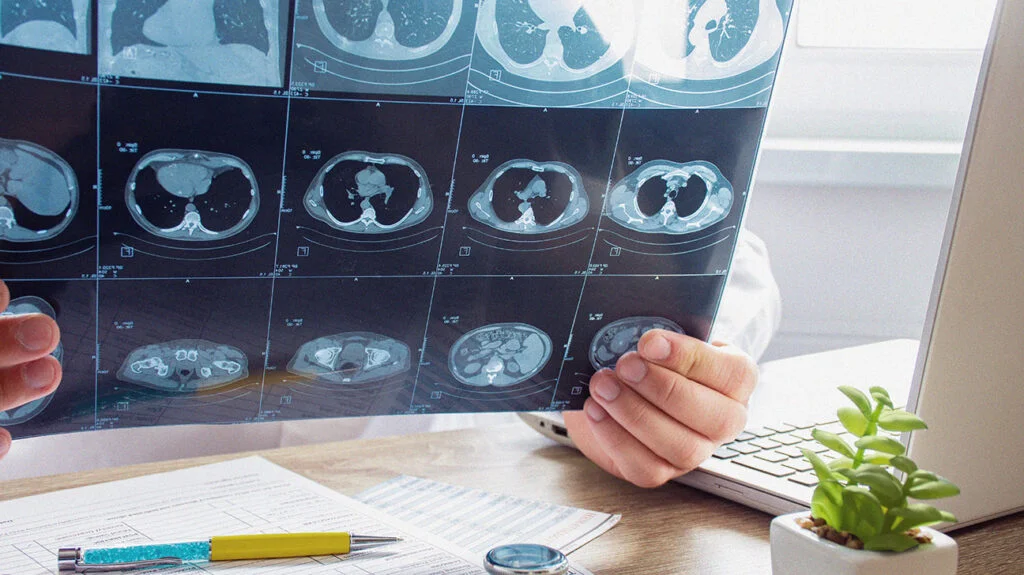
Chest X-ray is the first and most practical method used for the detection of cysts; They are observed as well-demarcated, rounded shadows.
Computed Tomography (CT) provides millimetric details about the internal structure of the cyst, its wall thickness and its neighborhood with the surrounding tissues.
In particular, typical radiological findings of hydatid cyst such as the “water lily” or “crescent” sign are clarified by tomography.
Serological Blood Tests and Immunological Evaluation
Especially in the case of suspicion of hydatid cyst, blood tests (UAV, ELISA, etc.) are performed to detect antibodies produced by the body against the parasite.
While these tests can support the diagnosis, they may not always provide 100% results; therefore, it should be evaluated together with radiological findings.
In addition, in case of infection, high white blood cells (leukocytes) in the blood and infection parameters are monitored.
Lung Cyst Treatment Methods
The treatment approach for lung cysts is planned according to the type and size of the cyst and whether a complication (burst or infection) develops.
The main treatment of parasitic cysts (hydatid cyst) and congenital cysts is surgery; Because these structures cannot be completely destroyed by medication and tend to grow.
The main goal of treatment is to remove the cyst from the body while preserving the healthy lung tissue around it to the maximum extent.
Hydatid Cyst Surgery (Cystotomy and Capitonage)
The safest method accepted worldwide in hydatid cyst surgeries is the “Cystotomy and Capitonage” technique.
In this method, the fluid in the cyst (rock water) is first drained with a special needle without leaking into the surrounding tissues.
Then, the living inner membrane of the cyst, called the “germinal membrane”, is meticulously removed.
In the last stage, the cavity formed by the discharge of the cyst in the lung is closed by suturing from the inside to the outside with special sutures so that there is no air leakage (capitonage).
Closed Lung Cyst Surgery (VATS)
Today, cysts that are appropriately located and not very large are treated with a closed method called Video-Assisted Thoracoscopic Surgery (VATS).
In this procedure, which is performed by entering only one or two small holes without opening the rib cage, the surgeon watches the entire process on a high-resolution monitor.
Closed surgery shortens the patient’s hospital stay, reduces postoperative pain and leaves a much smaller scar aesthetically.
Lung Abscess and Drug Treatment Protocols
Lung abscesses, unlike cysts, are primarily managed with high-dose and long-term antibiotic therapy.
Depending on the patient’s condition, the treatment, which is started intravenously, can sometimes take 4 to 6 weeks.
If the abscess does not respond to antibiotic treatment, is too large or causes severe bloody sputum in the patient, surgical intervention or drainage methods are activated.
Recovery Process After Lung Cyst Surgery
The speed of recovery after surgery varies depending on the surgical method applied and the size of the cyst.
Patients can usually stand up and start light walks a few hours after surgery.
The chest tube inserted to prevent the lung from deflating is removed when the lung is fully expanded and the air leak is stopped (usually within 2-4 days).
It is recommended that discharged patients avoid heavy physical activities and continue breathing exercises for about 15 days.
Lung Cyst Treatment Approaches and Comparison Table
| Type of Cyst | Basic Treatment | Surgical Method | Hospital Stay |
| Hydatid Cyst | Surgery | VATS or Open (Cystotomy) | 3 – 5 Days |
| Congenital Cyst | Surgery | Usually VATS | 2 – 4 Days |
| Lung Abscess | Medicine (Antibiotic) | Surgery only in resistant cases | 7 – 14 Days |
What You Need to Know About Lung Cysts and Ways to Prevent Them
In particular, preventing parasitic cysts is as important a public health issue as surgery.
In order to prevent hydatid cyst, vegetables and fruits should be washed very well, and water of unknown origin should not be drunk.
Parasite medications of pets (dogs) should be done regularly, and most importantly, cystic offal should never be fed to stray animals during periods such as Eid al-Adha.
In order to prevent cysts and abscesses due to infection, attention should be paid to oral and dental health and the immune system should be kept strong.
Prof. Dr. Levent Alpay: Our priority in lung cyst surgeries performed in our clinic is to perform “lung-sparing surgery” accompanied by protective solutions that prevent the spread of the parasite. Our aim is not only to remove the cyst, but also not to sacrifice even a millimeter of the healthy lung tissue that the patient will need in his future life.
Case Experience (Anonymous):
A 28-year-old female patient who presented with back pain had an 8 cm diameter hydatid cyst in the lower lobe of the right lung. The patient underwent cystotomy and capitonage with the closed (VATS) method. During the surgery, all precautions were taken to prevent the cyst fluid from spreading to the surrounding area. The patient was discharged with healing on the 3rd day after the operation by removing the chest tube and successfully completed the process with 6 months of medication.
For detailed information, you can consult an expert opinion and make an appointment with our clinic.
Frequently Asked Questions
Does a Lung Cyst Go Away Without Surgery?
Hydatid cyst and true cystic structures do not disappear completely spontaneously or with medication alone; Surgery is a must for definitive treatment.
What Happens If a Lung Cyst Bursts? (Risk of Rupture)
The rupture of the cyst can cause the fluid inside to escape into the airways, causing a feeling of suffocation, severe cough and, most dangerously, allergic shock (anaphylaxis).
Does Lung Cyst Recur?
If the cyst membrane is completely removed during surgery and preventive measures are taken, the risk of recurrence is very low; However, if the patient does not comply with the protection rules, it may cause a new transmission.
Scientific Bibliography
- World Journal of Surgery: Surgical management of pulmonary hydatid cysts
- The Lancet Infectious Diseases: Hydatid disease: cystic echinococcosis of the lung
- PubMed (NCBI): Video-assisted thoracoscopic surgery for lung cysts
- Journal of Thoracic Disease: Management of lung abscesses and empyema