EN
EN


Ingredients
- Lung Cancer 3. What is Phase?
- Stage 3 Lung Cancer Characteristics (Stage 3A, 3B and 3C Differences)
- What Does Locally Advanced Stage Mean?
- Lung Cancer 3. What are the Stage Symptoms?
- Common Intrathoracic Symptoms
- Symptoms caused by the pressure of the tumor on neighboring organs
- Lung Cancer 3. How is Stage Treatment Done?
- Multidisciplinary Treatment Approach: Chemotherapy and Radiotherapy
- Lung Cancer 3. Can Stage Surgery Be Performed?
- Preoperative (Neoadjuvant) Treatment and Postoperative Process
- Lung Cancer 3. Stage Life Expectancy and Success Rates
- Impact of Immunotherapy and Smart Drugs on Survival
- Lung Cancer 3. Factors Affecting Stage Life Span
- Frequently Asked Questions
- Scientific Bibliography
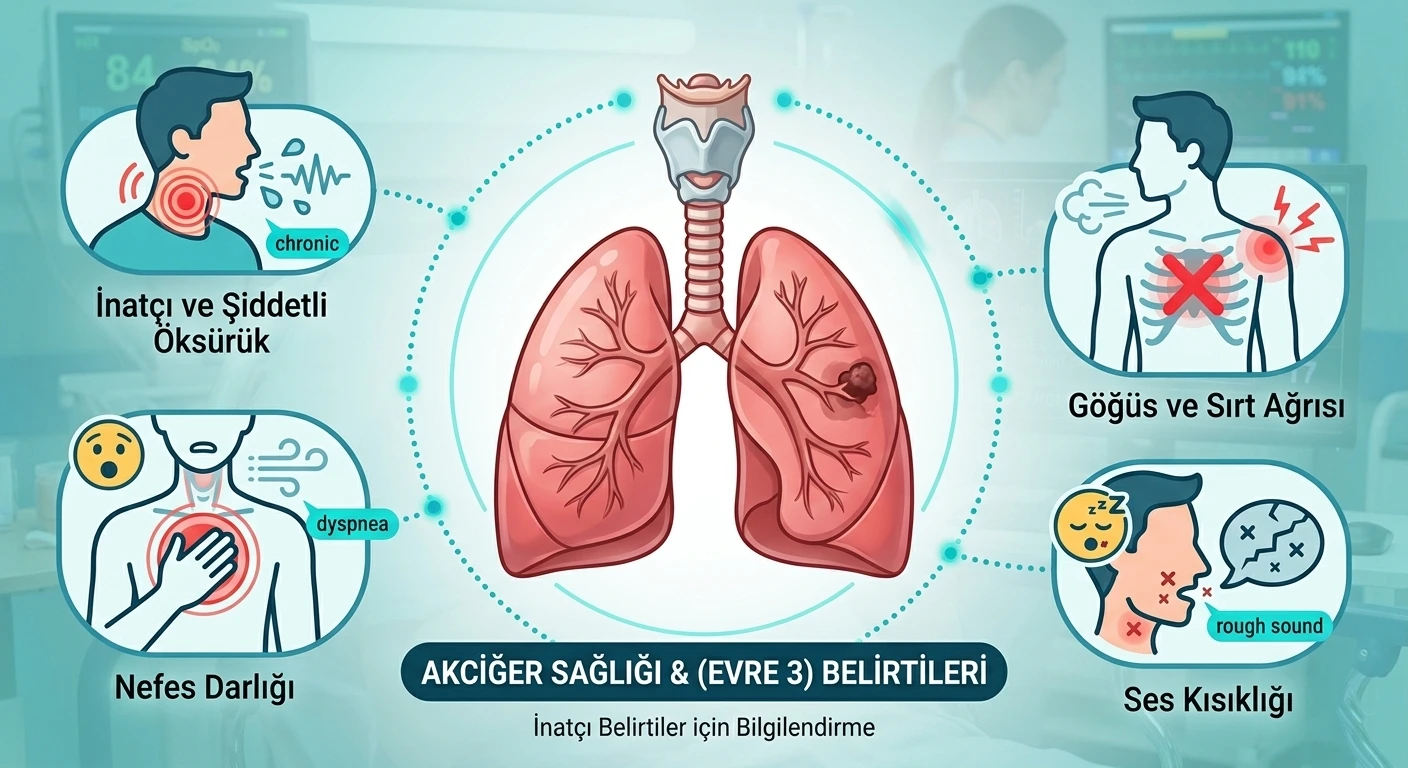
Symptoms of stage 3 lung cancer include:
- Persistent and Severe Cough
- Shortness of breath
- Chest and Back Pain
- Hoarseness
For patients diagnosed with lung cancer and their relatives, the staging process is the most decisive element of the treatment roadmap.
Lung cancer stage 3 is a stage where the disease is no longer limited to the lung tissue, but progresses to the lymph nodes in the rib cage or adjacent critical organs.
This stage is called the “locally advanced stage” in the medical literature and is the group that requires the most expertise to treat.
Advancements in modern oncology and thoracic surgery offer promising outcomes with multidisciplinary approaches for patients at this stage.
Lung Cancer 3. What is Phase?
Lung cancer stage 3 refers to conditions in which the tumor has spread to the lymph nodes in the midline (mediastinum) of the lung, regardless of its size.
The presence of cancer at this stage indicates that it has not yet spread to distant organs such as the liver, brain, or bone.
However, detailed mapping is essential to determine surgical margins and treatment options.
Stage 3 Lung Cancer Characteristics (Stage 3A, 3B and 3C Differences)
The third stage is divided into three subcategories according to the extent of the spread of the disease.
In stage 3 lung cancer cases, group 3A includes “resectable” cases where the tumor still has the potential to be surgically removed.
In stages 3B and 3C, the tumor has reached a larger network of lymph nodes or critical areas such as the large vessels leading to the heart.
What Does Locally Advanced Stage Mean?
The locally advanced stage is a “transitional” period in which the cancer has come out of its birthplace but has not yet spread throughout the body.
In this process, the correct treatment strategy is to prevent the disease from progressing to stage 4 and to make the patient suitable for surgery again.
Lung Cancer 3. What are the Stage Symptoms?
As the disease progresses, the body’s signals become more pronounced and affect daily life.
Lung cancer stage 3 symptoms may differ depending on the area of spread of the tumor in the chest cavity.
Common Intrathoracic Symptoms
- Persistent and Severe Cough: Cough that lasts for weeks and is often accompanied by sputum, sometimes bloody in character.
- Shortness of Breath: Shortness of breath that can be felt even at rest as a result of the tumor narrowing the main airways.
- Chest and Back Pain: Stabbing pain caused by the tumor pressing on the chest wall or nerve endings.
- Hoarseness: Sudden voice changes that occur as a result of the nerve that controls the vocal cords being under tumor pressure.
Symptoms caused by the pressure of the tumor on neighboring organs
The tumor can sometimes press on the esophagus, causing difficulty swallowing (dysphagia).
In addition, the development of swelling in the face and neck area (superior vena cava syndrome) may be an indication of obstructions at this stage.
Although expressions such as lung cancer stage 3 death symptoms , which are frequently found in internet searches, usually refer to the end stages that cannot be cured, the vast majority of stage 3 patients are individuals under active treatment and such symptoms can usually be controlled.
Lung Cancer 3. How is Stage Treatment Done?
Lung cancer stage 3 treatment is not a single method, but a combined process in which surgery, chemotherapy, radiotherapy and immunotherapy are used together.
Multidisciplinary Treatment Approach: Chemotherapy and Radiotherapy
In many patients, treatment is started with “simultaneous chemoradiotherapy”.
The aim here is to control the tumor by shrinking it and, if possible, to prepare the patient for the surgical stage.
Lung Cancer 3. Can Stage Surgery Be Performed?
One of the most frequently asked questions is: Can lung cancer stage 3 be operated ?
If the tumor is at stage 3A or has been reduced with preliminary treatments (downstaging), surgical intervention becomes the most effective option.
In the operation, all mediastinal lymph nodes are meticulously cleaned together with the tumor lung section.
Preoperative (Neoadjuvant) Treatment and Postoperative Process
Neoadjuvant treatments given before surgery help the surgeon remove the tumor with safer margins.
The use of immunotherapy has become standard in recent years to reduce the risk of recurrence after surgery in stage three cases of lung cancer.
Stage 3 Treatment Options Comparison Table
| Treatment Model | Application Purpose | Expected Impact |
| Chemoradiotherapy | Shrinking the tumor | Local control and phase reduction |
| Surgery (Lobectomy) | Removing the tumor from the body | Long-term survival and cure |
| Immunotherapy | Stimulating immunity | Minimizing the risk of recurrence |
| Targeted Therapy | Targeting the genetic mutation | Systemic control with low side effects |
Prof. Dr. Levent Alpay: When you are diagnosed with stage three, do not despair by thinking “I have no chance of surgery”.
Today, thanks to the new generation drugs we apply before surgery, we can successfully operate on many patients who were previously said to be unable to perform surgery.
The important thing is that your treatment is managed in a center where a thoracic surgeon, medical oncologist, and radiation oncologist work together.
Lung Cancer 3. Stage Life Expectancy and Success Rates
Although the statistics only paint a general picture, each patient’s biological response and adherence to treatment is different.
Lung cancer stage 3 life expectancy has more than doubled in the last decade with the inclusion of immunotherapy.
Impact of Immunotherapy and Smart Drugs on Survival
In the past, survival rates were lower for stage three of lung cancer .
However, today, patients can live a quality life for many years thanks to drugs that train the immune system to fight against cancer.
Lung Cancer 3. Factors Affecting Stage Life Span
The patient’s overall performance, the tumor’s genetic mutations (EGFR, ALK, etc.) and the initial response to treatment are decisive.
According to general statistics, the chance of experiencing stage 3 lung cancer can exceed the 30% to 40% band in groups receiving multidisciplinary treatment.
Early diagnosis and aggressive treatment approaches increase these figures day by day.
Clinical Experience and Case Example (Anonymous):
A 55-year-old patient diagnosed with stage 3A and who could not be operated directly due to lymph node involvement was first treated with chemoradiotherapy.
After it was determined that the tumor had shrunk by 60%, it was operated on with the closed method.
Our patient, who completed the process with immunotherapy after the operation, is under our follow-up in the 5th year without recurrence.
Frequently Asked Questions
How long does stage 3 of lung cancer live?
Although life expectancy varies according to the patient’s general health status, genetic mutations and response to treatment, five-year survival rates are between 15% and 35% thanks to new generation immunotherapies and smart drugs.
Can stage 3 lung cancer be operated?
This phase is divided into 3A, 3B and 3C; While some patients in stage 3A can be operated on by shrinking the tumor after chemotherapy or radiotherapy, radiochemotherapy and immunotherapy are generally preferred over surgery in stages 3B and 3C.
What is good for lung cancer stage 3?
In addition to medical treatment, a high-protein diet, complete cessation of smoking, light walks under the supervision of a doctor and an immune-supporting Mediterranean-type diet are good for the patient’s quality of life.
Is stage 3 cancer completely cured?
Complete recovery (remission) is possible at this stage; The disease can be completely controlled, especially with chemotherapy, radiotherapy and current immunotherapy combinations called multimodality.
Scientific Bibliography
- The New England Journal of Medicine (NEJM): Durvalumab after Chemoradiotherapy in Stage III Non–Small-Cell Lung Cancer (PACIFIC Study)
- The Lancet Oncology: Multimodality treatment for stage III non-small-cell lung cancer
- PubMed Central: Current Surgical Perspectives on Stage IIIA Lung Cancer
- Journal of Thoracic Oncology (IASLC): The 8th Edition Lung Cancer Stage Classification