 EN
EN




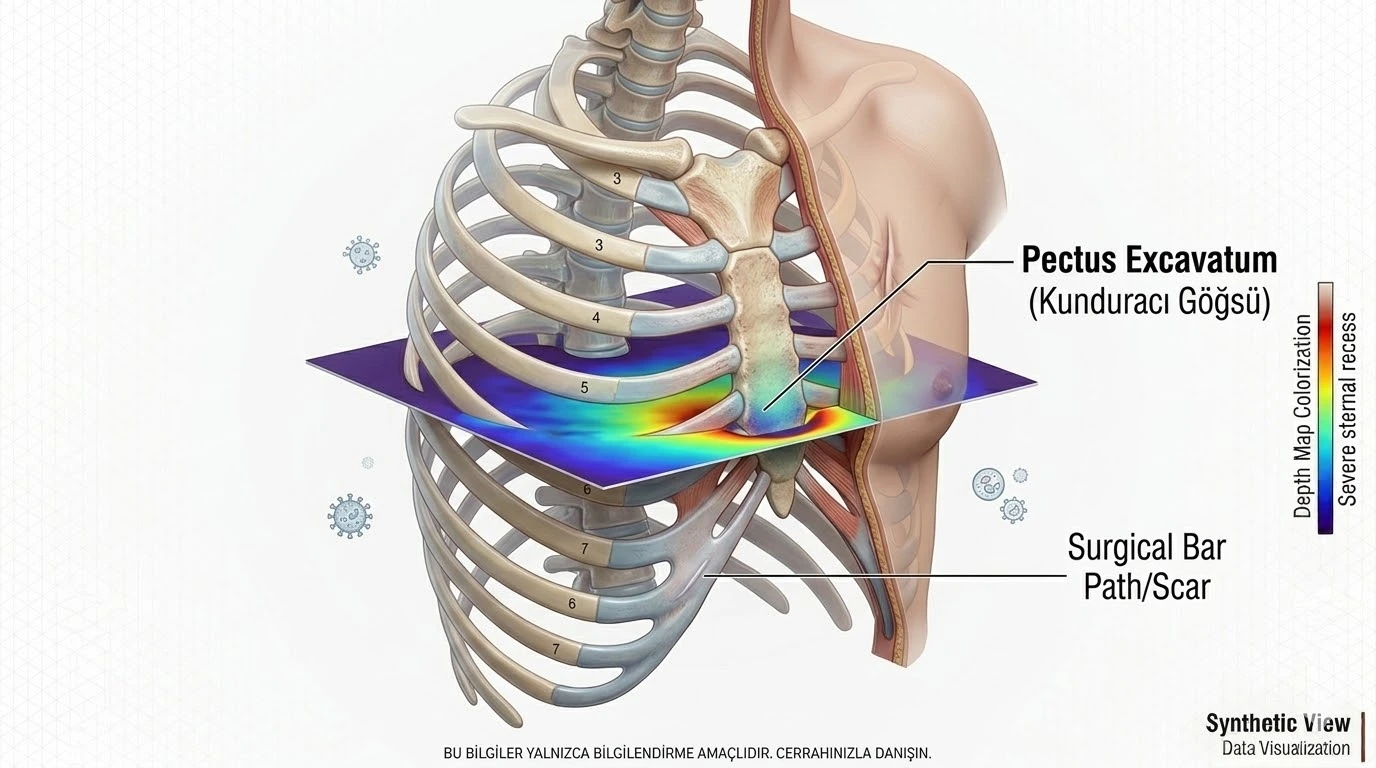
Shoemaker’s chest, known as Pectus Excavatum in the medical literature, is a rib cage deformity characterized by the collapse of the sternum bone, known as the sternum, towards the spine.
In society, it is generally perceived as a cosmetic defect that concerns only appearance.
However, from a surgical perspective, the mechanical stress of this condition on vital organs and the implications for a patient’s quality of life extend far beyond aesthetic considerations.
As the depth of the collapse increases, the volume in the rib cage narrows and this can restrict the functions of the heart and lungs.
Physiological Effects and Health Risks of Pectus Excavatum
The rib cage is a lattice structure that protects vital organs and provides the necessary volume for their functioning.
In cases of shoemaker’s chest, the inward collapse directly narrows the internal volume of this cage.
Pressure on the Heart (Compression) and Rhythm Disorders
The inward collapse of the sternum creates direct pressure on the right ventricle (right ventricle) part of the heart.
This mechanical compression can restrict the heart’s capacity to fill with blood.
In advanced cases, it is observed that the heart is displaced (shifted to the left).
Patients may experience complaints such as palpitations, rhythm disturbances or chest pain during exertion due to this pressure.
Complaints of Decreased Lung Capacity and Shortness of Breath
The collapsed bone structure prevents the lungs from fully expanding.
This condition, which causes a restrictive lung pattern, leads to a decrease in respiratory capacity (vital capacity).
This limitation, which is not noticed at rest, occurs as shortness of breath when the body’s oxygen demand increases.
Exercise Intolerance: Physical Causes of Fatigue
Individuals with pectus excavatumtend to tire more quickly in sports activities compared to their peers.
This is mainly due to the fact that both the amount of blood pumped by the heart in one beat (stroke volume) and the oxygen intake capacity of the lungs are at the limit.
Exercise intolerance is an important medical indication that negatively affects a patient’s physical development and overall fitness.
Medical Evaluation Criteria: Aesthetic or Functional?
Objective measurement methods are used to understand whether a patient’s condition is just a visual defect or a disease that needs to be treated.
Haller Index: How to Measure the Severity of Collapse?
The Haller Index calculation made on computed tomography (CT) or MRI images is the most reliable parameter.
It is obtained by dividing the transverse diameter of the rib cage from the inside by the depth of the sternum at the point where it is most collapsed.
- Normal Value: It is at the level of approximately 2.5.
- Surgical Margin: Values of 3.25 and above indicate that heart-lung compression is significant and surgical intervention should be considered.
The Role of Echocardiography (ECHO) and Pulmonary Function Tests
With the ECHO test, whether the heart is under pressure and the functioning of the valves (especially the risk of Mitral Valve Prolapse) are examined.
Pulmonary function tests (PFT) numerically reveal the loss of lung volumes.
The results of these tests determine the point at which the decision for surgery evolves from aesthetic concerns to medical necessity.
The Effect of Rib Cage Deformity on Posture Disorders
In patients with pectus excavatum, it is often accompanied by the appearance of “slumped shoulder”, “hunchback” (kyphosis) and “dislocated abdomen”.
These posture disorders develop as a result of an effort to hide the deformity in the rib cage and can lead to chronic back and lower back pain over time.
Prof. Dr. Levent Alpay: The ‘introverted shoulder’ posture we see in young people with pectus excavatum is not just a posture disorder, but a physical reflection of the psychological burden created by the deformity. In cases with a high Haller Index, surgical correction improves not only the chest, but also the patient’s entire spinal health and self-confidence.
Psychological and Social Dimensions of Shoemaker’s Chest
As well as the physical effects, the effects of the deformity on the mental health of the individual should be evaluated within the scope of “medical necessity”.
Loss of Self-Confidence and Social Isolation in Adolescence
The deformity often becomes more pronounced during the rapid growth period in adolescence.
To hide this difference in their bodies, young people may exhibit behaviors such as avoiding swimming, wearing loose clothes and withdrawing from social environments.
Body Image Disorder and Its Effects on Quality of Life
Dissatisfaction with body image can pave the way for depression and social anxiety.
Many cases consult a physician because of this psychosocial pressure rather than their physical complaints.
Studies around the world prove a dramatic increase in quality of life scales after surgical correction.
When is Treatment Necessary? Functional Indications
Not every pectus patient is operated on. However, certain situations necessitate intervention.
Severe Collapses Restricting Daily Activities
Panting while climbing stairs, inability to participate in sports classes, or a constant feeling of pressure in the chest area are all signs of functional limitation.
Deformity Levels Threatening Heart and Lung Health
Treatment should not be delayed in patients with a clear crushing of the right ventricle of the heart or a murmur on CT images.
Treatment Options Comparison Table
| Feature | Vacuum Bell (Non-Surgical) | Nuss Surgery (Closed Surgery) |
| Method of administration | External vacuum device | Steel/titanium bar placed under the bust |
| Ideal Age | Young childhood and flexible chest structure | Adolescence and beyond |
| Process | A few hours a day, 1-2 years of use | The bar stays inside for 2-3 years |
| Success Rate | Effective in mild to moderate cases | The gold standard in advanced and asymmetrical cases |
| Hospitalization | Not required |
Frequently Asked Questions
1. Does shoemaker’s chest improve on its own over time?
Unfortunately, pectus excavatum is not a self-resolving deformity. On the contrary, with rapid growth during adolescence, the depression tends to deepen.
2. What is the best age for surgery?
The ideal age range is usually between 12-18 years old. The rib cage is still flexible and the healing rate is high. However, today it can also be successfully applied to older adults.
3. Will there be a lot of pain after Nuss surgery?
Pain management in the first few days after surgery is provided with an epidural catheter or patient-controlled analgesia (PCA). Pain has been minimized with modern techniques and cryoanalgesia (nerve freezing) applications.
4. Do pectus bars prevent sports?
Heavy sports should be avoided for the first 2-3 months after surgery. However, after the recovery is completed, patients can safely do sports such as swimming, fitness and jogging even when there are bars. Only combat sports (kickboxing, karate, etc.) are not recommended.
5. Does insurance cover this surgery?
Cases with a Haller Index above 3.25 and whose heart-lung compression is proven by medical tests (ECHO, PFT) are generally covered by insurance because they are considered within the scope of “medical necessity”, not aesthetics.
This information is for general informational purposes only; It is recommended to consult a healthcare provider for your condition.
Scientific Bibliography
- Journal of the American Board of Family Medicine (2010): Current management of pectus excavatum: a review and update of therapy and treatment recommendations – Jaroszewski D et al.
- Chest Wall Deformities and Cardiac Function – PubMed
- Journal of Pediatric Surgery (1998): A 10-year review of a minimally invasive technique for the correction of pectus excavatum – Nuss D et al.