 EN
EN




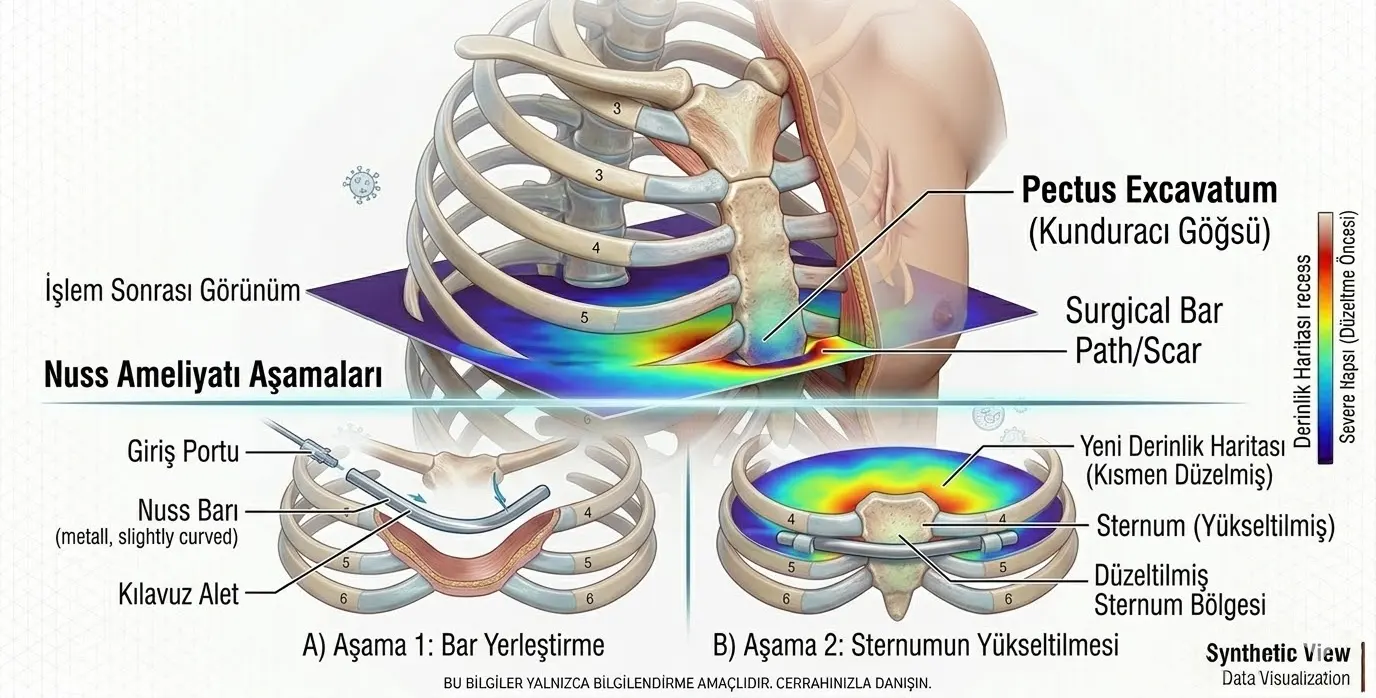
Nuss surgery is a minimally invasive (closed) surgical method used in the treatment of shoemaker’s chest (pectus excavatum).
It is considered the gold standard today due to the fact that it is performed with much smaller incisions than traditional open surgeries and the speed of the healing process.
We have brought together the technical details, operation process and recovery stages that patients and families are most curious about this procedure in 10 basic questions.
Top 10 Questions About Nuss Surgery
1. What is the Best Age for Nuss Surgery?
The ideal age range for surgery is usually between 12-18 years old.
During this period, the rib cage is still flexible and bone development responds best to surgical correction.
However, with the developing technology, this method can also be successfully applied to adult patients who are deemed suitable.
2. How is Post-Surgery Pain Management Provided?
The first few days after Nuss surgery are the most critical period for pain management.
Epidural analgesia or patient-controlled pain relief (PCA) systems are used in the hospital.
In recent years, pain transmission in the surgical area has been temporarily stopped with the “Cryoanalgesia” (nerve freezing) method, which allows patients to have a much more comfortable recovery period.
3. How long should bars on the ribcage stay?
The placed bars usually remain in the rib cage for 2.5 to 3 years.
This time is necessary for the breastbone to be permanently shaped in its new position.
At the end of the period, the bars are removed with a closed and short-term procedure.
4. Can You Do Sports While There Are Bars?
Heavy physical activities should be avoided for the first 3 months after surgery.
However, after the 3rd month, sports such as swimming, jogging and fitness can be started gradually.
It is recommended to avoid contact sports where there is a risk of impact to the ribcage, such as taekwondo, karate, or football, while the bars are on the body.
5. Will There Be Any Surgical Scars?
Since Nuss surgery is a minimally invasive method, only small incision scars of 2-3 centimeters remain on the sides of the chest.
When viewed from the front, no surgical scars are visible, which provides a great cosmetic advantage.
6. What is the success rate of the surgery?
The success rate of the Nuss procedure is over 95% with proper patient selection and an experienced surgical team.
The vast majority of patients are highly satisfied with both functional (reduced shortness of breath) and aesthetic results.
7. Do Bars Sing at Airport Security Gates?
The bars used can often trigger metal detectors.
For this reason, patients are given a signed surgical ID card or epicrisis report stating that they have a medical implant in their body.
8. What are the Risks and Complications of the Surgery?
As with any surgical procedure, Nuss surgery has low risks such as bar slippage, infection or air collection between the lung membranes (pneumothorax).
However, with advanced fixing techniques, the risk of bar slippage has decreased to less than 1%.
9. When can I return to daily life after surgery?
Patients are usually discharged after 5 days of hospitalization.
The time to return to school or office work is usually 2-3 weeks.
Full recovery and transition to normal physical activity takes about 3 months.
10. Is Nuss Surgery Covered by Insurance?
Cases with a Haller Index of 3.25 and above, whose heart or lung compression has been proven by medical tests, are considered “medical necessity”.
Patients who meet these criteria are usually eligible for SSI and private health insurance coverage.
Prof. Dr. Levent Alpay: The most important rule after Nuss surgery is patience. It is vital to avoid sudden body movements and heavy lifting, especially during the first 6 weeks, so that the bars fully adapt to the texture. Our preference for the cryoanalgesia method in pain management allows our patients to walk comfortably even on the second day after surgery.
Comparison of Nuss Surgery and Other Methods
| Feature | Nuss Surgery (Closed) | Ravitch Surgery (Open) | Vacuum Bell (Non-Surgical) |
| Incision Site | Chest sides (Small) | Front of the chest (Wide) | There is no incision |
| Bone Intervention | None | Cartilage bone is removed | None |
| Hospital Stay | 4-5 Days | 7-10 Days | Not required |
| Cosmetic Conclusion | Excellent | Obvious scarring remains | Effective in mild cases |
| Speed of Recovery | Very Fast | Slow | The process is long |
Post-Surgery Recovery Tips
- Posture: Trying to stand upright distributes the pressure of the bars more evenly.
- Breathing Exercises: The use of Triflo should not be neglected to maintain lung capacity after surgery.
- Sleeping Position: It is recommended to lie on your back for the first few months to keep the bars in place.
This information is for general informational purposes only; It is recommended to consult a healthcare provider for your condition.
Scientific Bibliography
- Nuss Procedure for Pectus Excavatum – PubMed
- Interactive CardioVascular and Thoracic Surgery (2020): Intercostal nerve cryoablation versus thoracic epidural for postoperative analgesia following pectus excavatum repair: a systematic review and meta-analysis – Daemen JHT et al.
- Annals of Surgery (2010): Twenty-one years of experience with minimally invasive repair of pectus excavatum by the Nuss procedure in 1215 patients – Kelly RE et al.