 EN
EN




Ingredients
- What is Open Lung Surgery (Thoracotomy)?
- In Which Situations Is Thoracotomy Method Preferred?
- How is Open Lung Surgery (Thoracotomy) Performed?
- Advantages of Thoracotomy Surgery
- Recovery Process After Open Surgery (Thoracotomy)
- Hospitalization Process and Pain Management
- Postoperative Breathing Exercises and Physiotherapy
- Home Care and Return to Daily Activities
- Comparison of Open and Closed Lung Surgery
- Which Method is More Suitable for Which Patient?
- Frequently Asked Questions
- How many hours does open lung surgery take?
- How is open lung surgery performed?
- In which cases is open lung surgery performed?
- What happens after lung surgery?
- How long does the pain last after open lung surgery?
- Scientific Bibliography
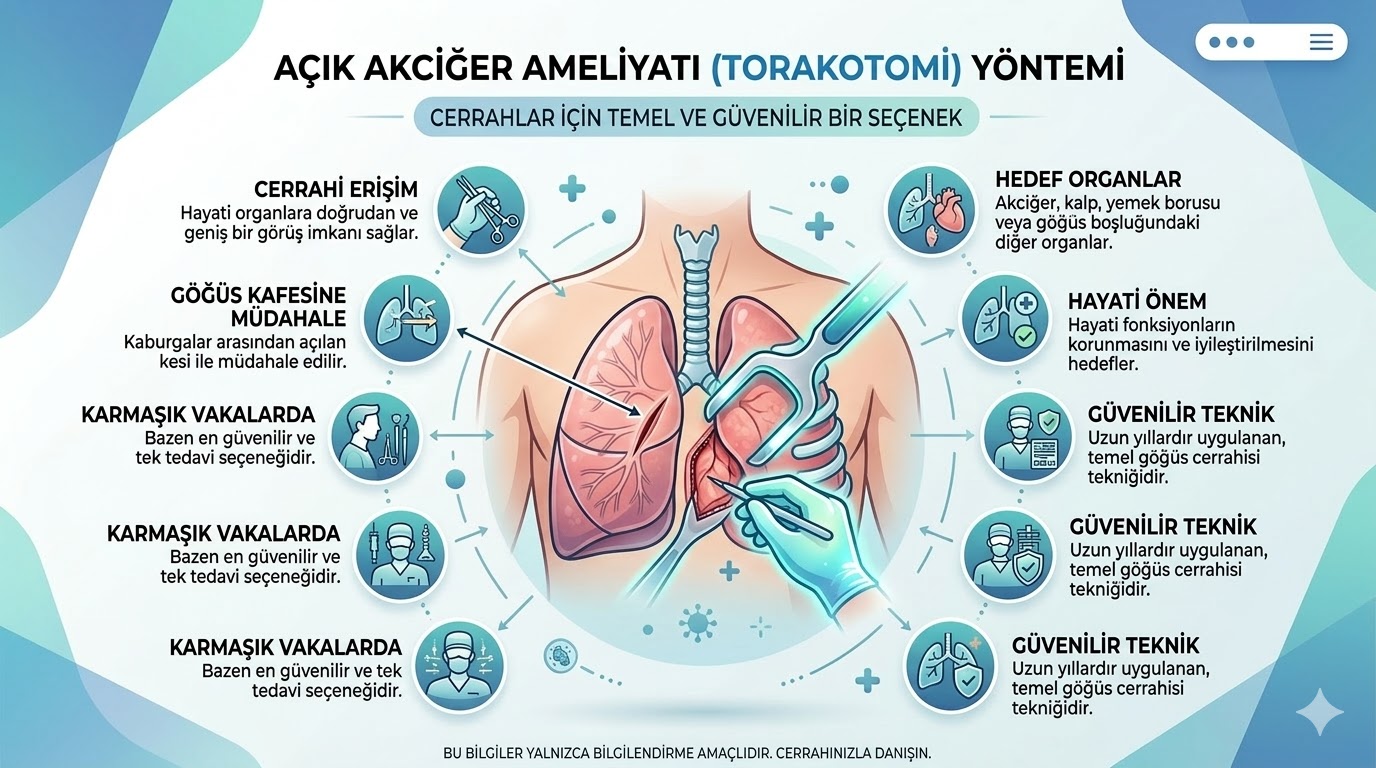
Although closed techniques have come to the fore in the modern medical world, open lung surgery, or thoracotomy, continues to form the cornerstone of thoracic surgery.
This method allows the surgeon to intervene in the lung, heart, esophagus, or other organs in the chest cavity by providing direct access to the rib cage.
This vital operation is performed as the most reliable and sometimes the only option in certain complex cases.
What is Open Lung Surgery (Thoracotomy)?
Thoracotomy is the process of opening the rib cage with an incision made between two ribs in the chest wall.
Unlike closed methods, in this technique, the surgeon sees the operation site directly with the naked eye and can intervene in the tissues with his hands.
This surgical approach, which has been developed for decades, has now turned into a much more comfortable process with advanced anesthesia and pain control methods.
In Which Situations Is Thoracotomy Method Preferred?
Thoracotomy (open surgery) is preferred as a vital assurance in cases where technological possibilities are limited or the risk increases. The main situations in which this method is preferred are as follows:
- Large-Sized Tumors: It is usually applied to safely remove masses that exceed 7-10 centimeters in size or spread to surrounding tissues such as the chest wall and ribs.
- Advanced and Complex Cases: It provides a wide field of view in cases where the tumor surrounds the main vessels or bronchi and requires precise vessel suturing (reconstruction).
- Emergency Surgical Interventions: It is the fastest way of access in uncontrolled bleeding due to severe traumas, traffic accidents or penetrating injuries.
- Security Pass: In surgeries that start closed (VATS/RATS), this method is switched within seconds in order to protect patient safety when a technical difficulty, severe adhesion or unexpected bleeding develops.
- Dense Adhesions: In cases where the lung is very tightly attached to the chest wall due to previous severe infections (tuberculosis, etc.) or radiotherapy, it is safer to proceed with the sense of touch.
- Precise Oncological Cleaning: In some special cases, the surgeon may need to remove the tumor tissue and lymph nodes by feeling them personally (palpation).
How is Open Lung Surgery (Thoracotomy) Performed?
The technical application stages of the thoracotomy operation are carried out in the following steps to keep the patient’s safety and surgical success at the highest level:
- Before the operation, pulmonary function tests (PFT) and cardiological examinations confirm the patient’s suitability for surgery.
- According to the area to be used, the most suitable one for the patient is determined from the postero-lateral or antero-lateral incision methods.
- The intercostal muscles are meticulously separated, and with the help of special retractors, the lung tissue is accessed without damaging the ribs.
- The surgeon isolates the tumor tissue or diseased area from the surrounding vascular and nerve structures thanks to direct vision and the sense of touch.
- Before the procedure is completed, the lungs are inflated and checked for any air leaks with a water test.
- The operation is terminated by placing one or two chest tubes (drains) to drain the fluid and air in the surgical field.
Recommendations under the title of Prof. Dr. Levent Alpay: “Although our patients are sometimes concerned due to the incision size of open surgery, in some cases this wide field of view is the key to oncological success. Remember that your surgeon’s primary goal is not to make the smallest incision, but to remove the tumor tissue from the body in the safest and most complete way.”
Advantages of Thoracotomy Surgery
Open lung surgery (thoracotomy) offers the following critical advantages thanks to the direct control mechanisms it provides to the surgeon in advanced cases:
- The surgeon’s personal palpation of the tissue allows the detection of millimetric and deep-seated nodules that cannot be detected on radiological imaging.
- The wide surgical field allows for clear differentiation of anatomical structures, especially in patients with complex vessel variations.
- In cases where tissues fuse together due to previous infection or radiotherapy, tissue separation with open surgery is much safer than closed methods.
- By providing direct access to lymph node stations around the tumor, it increases the success of “zero residue” (R0 resection), which is the main goal in cancer surgery.
- It gives the chance to intervene directly in unexpected vascular injuries or bleeding that may develop during surgery within seconds.
- It facilitates the removal of masses that are too large for closed surgical instruments to maneuver, without fragmentation and in accordance with oncological principles.
Treatment and Comparison Table
| Feature | VATS (Off) | Thoracotomy (Open) |
| Application Area | Early-Stage Cases | Large or Complex Tumors |
| Vision | With camera (2D/3D) | Direct (Naked Eye) |
| Hospital Stay | 3-5 Days | 5-8 Days |
| Emergency Response Capacity | Limited | Very High |
| Surgical Precision | Technological | Manual/Tactile |
Recovery Process After Open Surgery (Thoracotomy)
Recovery after open surgery requires a little more patience and active participation than the closed method.
Hospitalization Process and Pain Management
After surgery, patients are usually kept in intensive care for 1 night or in special services that are closely monitored.
Thanks to modern pain pumps (epidural catheters), patients are prevented from experiencing serious pain despite the size of the incision.
Postoperative Breathing Exercises and Physiotherapy
The most critical part of recovery is the regular use of a breathing exercise device called “triflo”.
It is vital for the patient to stand up and walk in the corridor the day after the surgery to open the lungs at full capacity and to remove edema.
Home Care and Return to Daily Activities
After discharge, incision site cleaning and protein-based nutrition accelerate tissue healing.
It is recommended that patients avoid heavy lifting for the first month, but take regular light-paced walks every day.
Risks of Thoracotomy Surgery and Things to Consider
Critical points to be considered in order to minimize the risks and have a healthy recovery process after open lung surgery (thoracotomy) are as follows:
- Air Leakage Management: Drain monitoring and correct breathing techniques are vital to prevent prolonged air leaks from lung tissue after surgery.
- Infection Control: Regular doctor check-ups and compliance with hygiene rules are essential against the risk of infection (pneumonia) that may occur in the surgical field or lungs.
- Breathing Exercises: Breathing exercise tools such as triflo should be used in a disciplined manner to ensure that the lungs open at full capacity and prevent secretion accumulation.
- Smoking and Tobacco Products: It is imperative to completely quit smoking before and after surgery, which directly reduces the healing rate and increases the risk of complications.
- Nutritional Support: A diet rich in protein, vitamin C and zinc should be followed for tissue repair and strengthening of the immune system.
- Neuropathic Pain Management: Special medications prescribed by the physician should be used for the tingling or numbness (neuropathic pain) that may occur during the healing process of the intercostal nerves.
- Active Life: In order to prevent clot formation (embolism), daily light-paced walks should be started early as the doctor allows.
Comparison of Open and Closed Lung Surgery
There is no single answer to the question of which method is better; The best method is the “safest for that patient” method.
Which Method is More Suitable for Which Patient?
While closed methods (VATS/RATS) are at the forefront in young, early-stage and low-risk patients; Thoracotomy may offer a more controlled process in elderly patients, with large masses or cardiovascular problems.
Your surgeon will recommend the most suitable way for you, putting all the risks and advantages on the scale.
Clinical Experience and Anonymous Case Example
Case C: In our 58-year-old patient with an 8-centimeter mass in the center of his lung that touches the large vessels, thoracotomy was planned, anticipating that the closed method would be risky.
Safe separation of vessels from the tumor during surgery was only possible with clear vision.
After the successful operation, our patient was discharged on the 7th day and was able to start the chemotherapy process in a healthy way by completely getting rid of the tumor.
You can seek expert opinion to get scientifically based information about open lung surgery and treatment options specific to your condition.
You can make an appointment at our clinic for the analysis of your health status and treatment planning.
Frequently Asked Questions
How many hours does open lung surgery take?
Depending on the complexity of the operation and the width of the area to be intervened, the process is usually completed between 2 and 5 hours.
How is open lung surgery performed?
It is performed under general anesthesia by passing through the ribs with an incision made on the side of the rib cage to reach the lung tissue directly and to perform the surgical procedure by watching it with the naked eye.
In which cases is open lung surgery performed?
It is preferred in complex cases where the tumor size is very large, the masses show severe adhesion to vital vessels, or closed methods are technically insufficient.
What happens after lung surgery?
After the surgery, patients are monitored in the intensive care unit or ward for a while, a chest tube that drains the air and fluid in the lungs is inserted, and breathing exercises are started in the early period.
How long does the pain last after open lung surgery?
Severe pain is controlled with effective painkillers in the first few days after surgery, but mild tingling and tenderness at the incision site may last for several weeks depending on tissue healing.
Scientific Bibliography
- PubMed: Thoracotomy vs. VATS: Survival outcomes
- Drugs (2020): Post-Thoracotomy Pain: Current Strategies for Prevention and Treatment – Gupta R et al.
- Annals of Cardiothoracic Surgery (2023): Evolution of minimally invasive thoracic surgery – Li Q et al.