 EN
EN




Ingredients
- What is Bronchoscopy? Why is it done?
- The Role of Bronchoscopy in Diagnosing and Treating Lung Diseases
- In Which Situations Is Bronchoscopy Necessary?
- What are the Types of Bronchoscopy?
- Flexible Bronchoscopy: Diagnostic Use
- Rigid Bronchoscopy: Surgical and Interventional Applications
- How is Bronchoscopy Performed? Application Process
- Pre-Procedure Preparation and Fasting Period
- Procedures Performed During Bronchoscopy: Biopsy and Lavage
- Anesthesia and Sedation Methods
- Diseases Diagnosed by Bronchoscopy
- Identifying Lung Cancer and Tumors
- Diagnosis of Infections, Tuberculosis, and Sarcoidosis
- Removal of Foreign Objects Escaping into the Trachea
- Interventional Bronchoscopy Applications
- Stent Insertion and Airway Opening Procedures
- Bronchial Thermoplasty and Laser Treatments
- Recovery and Follow-up Process After Bronchoscopy
- Post-Procedure Nutrition and Rest Recommendations
- Potential Side Effects and Symptoms to Watch Out For
- Frequently Asked Questions
- How Long Does the Bronchoscopy Procedure Take?
- Is Bronchoscopy a Painful Procedure?
- How Many Days Does the Biopsy Result Take?
- Scientific Bibliography
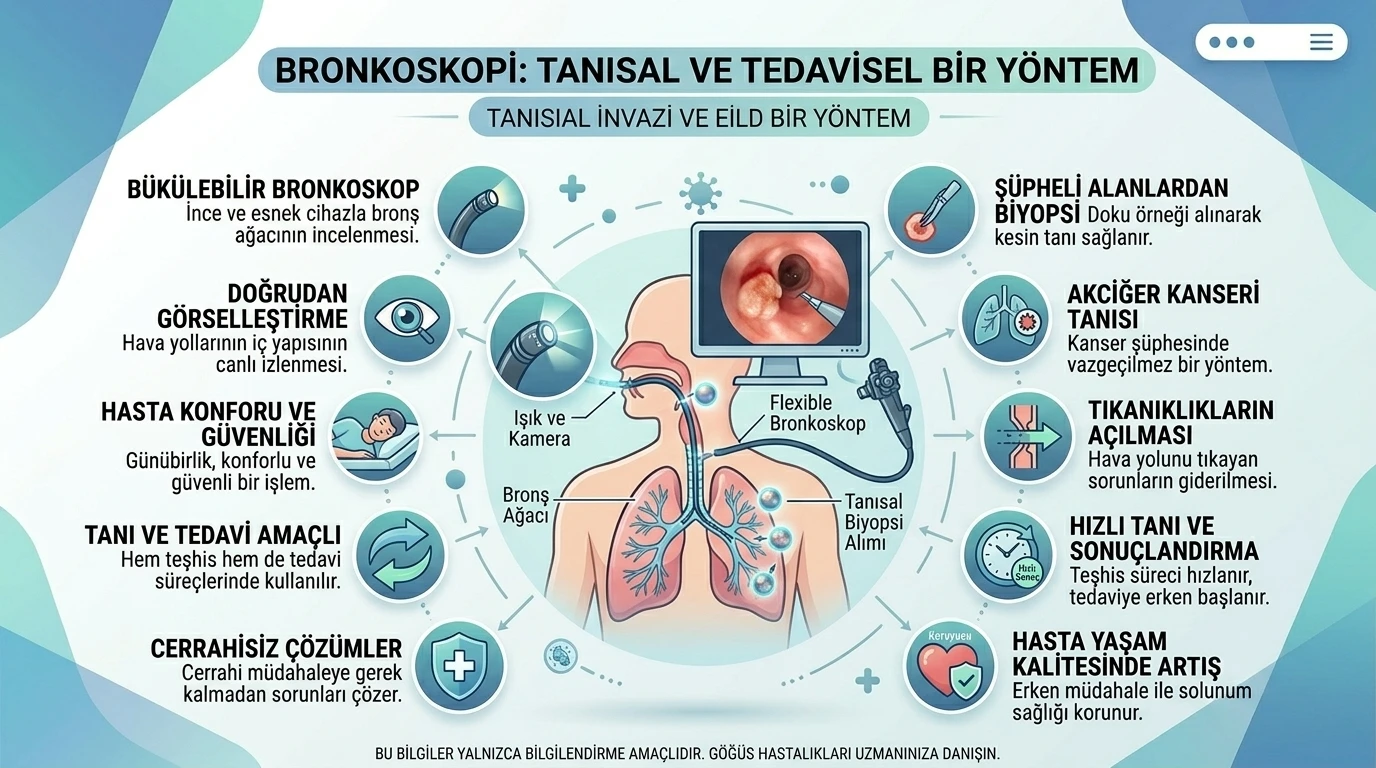
Bronchoscopy is a medical procedure that allows for a direct examination of the trachea and bronchial tree with a thin, bendable device with a light and camera at the end.
This procedure not only visualizes the internal structure of the lungs but also allows biopsies to be taken from suspicious areas or to open obstructions in the airway.
In modern thoracic surgery and pulmonology practice, it is an indispensable method for the definitive diagnosis of many respiratory system diseases, especially lung cancer.
Thanks to technological developments, bronchoscopy has become a very comfortable and safe day procedure for patients today.
This method, which is used for both diagnostic and therapeutic purposes, can solve the problems in the patient’s airways without the need for surgery.
What is Bronchoscopy? Why is it done?
Bronchoscopy is an advanced type of endoscopy used to reach “non-visual” or “suspicious” areas in the lungs.
This procedure is performed to understand the nature of a lesion detected on films such as x-rays or tomography, that is, to determine whether it is cancer or a simple infection.
The device used during the procedure, called a “bronchoscope”, advances to the farthest points of the airways and provides a real-time image to the surgeon.
The Role of Bronchoscopy in Diagnosing and Treating Lung Diseases
Bronchoscopy is not only a viewing procedure, but also a bridge that allows analysis at the tissue level.
Detection of narrowing, bleeding or foreign bodies in the airways can be performed within seconds with this method.
In the therapeutic role, stents can be inserted with special instruments passed through the bronchoscope, tumors can be cleaned with laser or strictures can be widened.
In Which Situations Is Bronchoscopy Necessary?
Your doctor may order a bronchoscopy to examine your lungs more closely in the presence of:
- Unexplained Cough: Persistent coughs that last longer than 3 weeks and do not respond to treatment.
- Coughing up blood (hemoptysis): To find the focus of bleeding in case of bleeding from the mouth with coughing.
- Abnormal Imaging Findings: In the presence of a suspicious mass, nodule or shadow seen on chest X-ray or tomography.
- Airway Obstructions: In the evaluation of tumors or strictures that cause shortness of breath.
- Foreign Body Suspicion: Especially in children or in removing substances that get into the trachea while eating.
What are the Types of Bronchoscopy?
Bronchoscopy is performed with two different technological equipment according to the patient’s needs.
Flexible Bronchoscopy: Diagnostic Use
It is the most widely used method; It is about the thickness of a pencil, extremely flexible and bendable.
It can be easily applied under local anesthesia and a slight state of drowsiness (sedation); It can be reached up to the smallest bronchial branches by entering through the patient’s nose or mouth.
It is ideal for taking a biopsy sample for diagnosis or collecting a sample of lung fluid (lavage) in the presence of infection.
Rigid Bronchoscopy: Surgical and Interventional Applications
It is a larger diameter, metal and non-bending pipe system; It is definitely applied under general anesthesia and operating room conditions.
It is preferred in cases that require “surgical” power, such as removing large foreign bodies in the airway, controlling severe bleeding and stent placement.
Rigid bronchoscopy offers the surgeon a wide working channel, allowing laser or freezing (cryo) treatments to be performed safely.
How is Bronchoscopy Performed? Application Process
The procedure consists of a series of steps planned to keep the patient’s comfort at the top.
Pre-Procedure Preparation and Fasting Period
It is vital that the stomach is completely empty before bronchoscopy to prevent stomach contents from escaping into the lungs (aspiration) during the procedure.
Patients are asked to stop eating and drinking at least 6-8 hours before the procedure, and if they smoke, they should definitely not drink that day.
If there are blood thinners used, this should be reported to the physician and discontinued under the supervision of a doctor a few days before the procedure.
Procedures Performed During Bronchoscopy: Biopsy and Lavage
- Biopsy: It is the removal of tiny pieces of suspicious tissue through a thin channel inside the bronchoscope.
- Brushing: It is the touching of the surface of the respiratory tract with a small brush to collect a cell sample.
- Lavage (Washing): It is the examination of the cells trapped in this fluid in the laboratory by giving sterile water to a small area of the lung and withdrawing it.
Anesthesia and Sedation Methods
In flexible bronchoscopy, “conscious sedation” is usually applied; The patient relaxes, is in a light sleep, but can hear commands.
Thanks to the numbing sprays sprayed into the throat area, there is no pain or gagging sensation during the procedure.
In rigid applications, the patient is completely anesthetized, so that he does not feel anything during the procedure and the intervention is completed safely by the surgeon.
Diseases Diagnosed by Bronchoscopy
Bronchoscopy is the most important detective tool of chest diseases and surgery.
Identifying Lung Cancer and Tumors
It is the primary method in staging lung cancer and determining the type of tumor (small cell, squamous cell, etc.).
How much the tumor narrows the trachea and whether it can be surgically removed is clarified by bronchoscopy.
Diagnosis of Infections, Tuberculosis, and Sarcoidosis
Systemic diseases such as persistent pneumonia, pulmonary tuberculosis or sarcoidosis that cannot be diagnosed by ordinary tests are confirmed by bronchoscopic sampling.
Determining the type of microorganism causing the infection, especially in patients with weakened immune systems, is critical for correct antibiotic treatment.
Removal of Foreign Objects Escaping into the Trachea
When foreign objects, such as nuts, peanuts, or small toy parts, get into the windpipe, bronchoscopy is an immediate and life-saving intervention.
Interventional Bronchoscopy Applications
Not only diagnosis, but now also treatment is possible bronchoscopically.
Stent Insertion and Airway Opening Procedures
In patients whose trachea is closed due to tumor or stenosis, special stents are placed in the area to allow the patient to breathe comfortably immediately.
Bronchial Thermoplasty and Laser Treatments
In patients with advanced asthma, thermoplasty, which thins the airway muscles, or laser procedures, which destroy cancerous tissues by burning, can be performed through a bronchoscope.
Bronchoscopy Comparison Table
| Feature | Flexible Bronchoscopy | Rigid Bronchoscopy |
| Anesthesia | Local + Sedation | General Anesthesia |
| Application Area | Diagnosis, Biopsy, Branches | Surgical Intervention, Stent, Foreign Body |
| Recovery Time | 2-4 Hours | 24 Hours |
| Image Quality | Very High (HD) | High |
| Hospital Stay | Daily | Usually 1 Day Hospitalization |
Prof. Dr. Levent Alpay: Bronchoscopy is the thoracic surgeon’s eye in the lungs. One of the biggest advantages that technology offers us is to be able to enter the patient through a hole as small as the tip of a needle and make the entire diagnosis before taking the patient to a major surgery. With the advanced bronchoscopic methods we apply in our clinic, we can not only diagnose, but also open the airways of our patients with shortness of breath within minutes with a stent or laser. Correct diagnosis is the first and most important step in correct treatment.
Case Experience (Anonymous):
A 2 cm lesion was detected in the right lung in the tomography taken in a 62-year-old smoker patient. In the examination performed with flexible bronchoscopy, biopsy and brushing samples were taken for cell-based diagnosis. In this way, the diagnosis of early-stage lung cancer was clarified within 3 days and the patient was taken into surgery before the disease spread and regained his full health.
If you have a suspicious finding in your lungs or are experiencing persistent respiratory complaints, you can make an appointment with our clinic for bronchoscopy and detailed evaluation and seek expert opinion.
Recovery and Follow-up Process After Bronchoscopy
After the procedure is over, the patient is taken to a short-term observation room.
Post-Procedure Nutrition and Rest Recommendations
You should not eat or drink anything until the numbness in the throat subsides (usually 2 hours); Otherwise, there is a risk of fluids escaping into the lungs.
It is normal to experience pain in the throat, hoarseness, or mild bloody sputum for the first few hours and usually goes away on its own.
Potential Side Effects and Symptoms to Watch Out For
Bronchoscopy is a very safe procedure, but like any interventional procedure, it carries risks, albeit low.
If severe chest pain, extreme shortness of breath or plenty of fresh blood comes out after the procedure, a doctor should be consulted immediately.
Frequently Asked Questions
How Long Does the Bronchoscopy Procedure Take?
Flexible bronchoscopy for diagnostic purposes usually takes between 15 and 30 minutes; however, a biopsy or therapeutic interventions may extend the duration slightly.
Is Bronchoscopy a Painful Procedure?
No, the patient does not feel pain during the procedure thanks to the local anesthesia and sedation applied; Only a slight fullness in the throat or a coughing reflex can be felt.
How Many Days Does the Biopsy Result Take?
Pathological examination of biopsy samples usually results in 3 to 5 working days; If special dyeing is required, this period may take up to a week.
Scientific Bibliography
- Thorax (2013): British Thoracic Society guideline for diagnostic flexible bronchoscopy in adults: accredited by NICE – Du Rand IA et al.
- PubMed (NCBI): Complications and Safety in Flexible Bronchoscopy
- European Respiratory Journal: Technical Advances in Interventional Pulmonology
- Turkish Thoracic Society: Bronchoscopy Practice Standards