 EN
EN




Ingredients
- Lung Cancer 4. What is Stage (Metastatic Stage)?
- Stage 4 Lung Cancer Characteristics (Stage 4A and 4B)
- What is Metastasis? Ways of Spread of Cancer
- Lung Cancer 4. What are the Stage Symptoms?
- Symptoms Varying According to the Spread Site (Brain, Bone, Liver)
- Lung Cancer End-Stage Symptoms and Quality of Life
- Lung Cancer 4. What to Know About Stage Death Symptoms
- Lung Cancer 4. How is Stage Treatment Done?
- Systemic Therapies: Immunotherapy and Smart Drugs
- Chemotherapy and Targeted Therapy Options
- The Role of Surgery and Radiotherapy in Stage 4 (Palliative Approaches)
- Lung Cancer 4. Stage Life Expectancy and Success Rates
- Lung Cancer 4. Phase Survival Chance: Statistics and New Developments
- Factors Influencing Lifespan and Personalized Medicine
- Scientific Bibliography
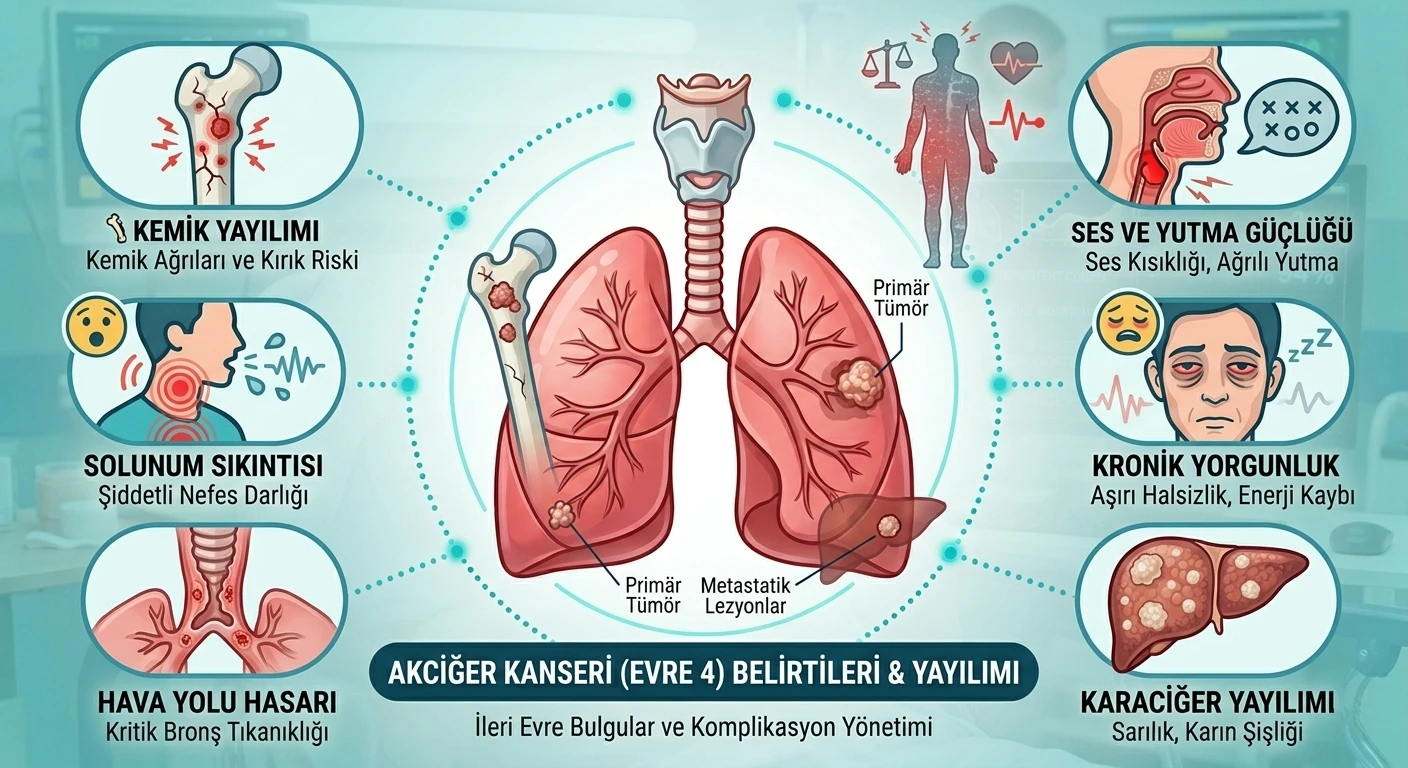
Lung cancer stage 4 symptoms include:
· Brain spread
· Bone spread
· Airway damage
· Respiratory distress
· Liver spread
· Systemic collapse
Chronic fatigue
· Sound and swallowing
Rapid developments in the medical world are opening new horizons even in disease stages that were very difficult to manage in the past.
Lung cancer stage 4 is the stage where the disease has spread to distant organs or tissues outside the lungs, requiring a systemic approach.
This stage is often defined as the “metastatic stage” and strategic treatments aimed at improving the patient’s overall quality of life come to the fore.
Modern oncology and thoracic surgery collaboration offers promising personalized treatment protocols for patients in stage four.
Lung Cancer 4. What is Stage (Metastatic Stage)?
Lung cancer stage 4 is the most advanced stage, where the primary tumor migrates to other parts of the body through blood or lymph.
In this phase, the focus is not only on the lungs but also on a systemic struggle involving the whole body.
The fact that the disease is at this level does not mean that the medical intervention is over; on the contrary, it is a process in which more sensitive and technological methods come into play.
Stage 4 Lung Cancer Characteristics (Stage 4A and 4B)
In medical classification, 4 stage lung cancer is divided into two according to the extent of spread.
Stage 4A refers to the condition where the cancer has spread to the other lung, pleura, or fluid around the heart.
Stage 4B describes the picture where cancer cells reach more than one distant organ, such as the liver, bone or brain.
What is Metastasis? Ways of Spread of Cancer
Metastasis is when cancer cells break away from the original tumor and form new colonies through the circulatory system.
The fourth stage diagnosis of cancer is made by detecting this microscopic migration by imaging methods (PET-CT, MRI).
Lung Cancer 4. What are the Stage Symptoms?
At this stage of the disease, symptoms are not limited to the chest area, but vary according to the organ to which it spreads.
Lung cancer stage 4 symptoms are caused by both the main mass in the lung and metastases in distant areas.
Symptoms Varying According to the Spread Site (Brain, Bone, Liver)
- Brain Metastasis: Severe headaches, loss of balance, visual disturbances, or sudden seizures.
- Bone Metastasis: Severe bone pain that does not go away, especially in the spine and hip area, and increases at night.
- Liver Metastasis: Pain in the upper right abdomen, loss of appetite, jaundice and abdominal bloating.
Lung Cancer End-Stage Symptoms and Quality of Life
As the disease progresses, shortness of breath, extreme weakness and uncontrolled weight loss become evident.
Lung cancer stage 4 bleeding from the mouth can be a sign of tumoral erosion of the airways and requires immediate medical evaluation.
These symptoms can be alleviated with modern palliative care and interventional bronchoscopic methods, improving the patient’s comfort.
Lung Cancer 4. What to Know About Stage Death Symptoms
The expression of lung cancer stage 4 death symptoms , which is widely researched on the internet, usually covers the terminal period when the disease no longer responds to treatment.
During this period, deep sleepiness, disruption of breathing patterns (Cheyne-Stokes breathing) and loss of swallowing reflex can be observed.
However, it should not be forgotten that not every stage four patient enters this process immediately; Many patients can delay this stage for years with new generation treatments.
Lung Cancer 4. How is Stage Treatment Done?
Surgery is no longer the first-line treatment in the treatment of stage four lung cancer, but it can play an auxiliary role in certain cases.
The backbone of treatment is drugs that act on the whole body and methods that control local symptoms.
Systemic Therapies: Immunotherapy and Smart Drugs
Today, the concept of lung cancer 4 stage recovery refers to the management of the disease as a chronic process rather than the complete destruction of the tumor.
While immunotherapy awakens the body’s immune cells to fight against cancer; Smart drugs target specific genetic mutations in the tumor.
Chemotherapy and Targeted Therapy Options
If no mutation suitable for smart drugs (such as EGFR, ALK, ROS1) is detected in the patient’s tumor, standard chemotherapy comes into play.
Chemotherapy aims to slow down the spread of stage four cancer by stopping cell division.
The Role of Surgery and Radiotherapy in Stage 4 (Palliative Approaches)
In the fourth stage, surgery is usually performed to relieve the patient, not to remove the main mass.
For example, it is possible to remove a tumor that is blocking the airway or to remove a single metastasis in the brain by surgery/radiosurgery (Gamma Knife).
Treatment Methods and Expected Effects Table
| Type of Treatment | Main Purpose | Benefit to the Patient |
| Immunotherapy | Activating the immune system | Long-term control and quality of life |
| Smart Medicines | Genetically targeted attack | High response rate and low side effects |
| Radiotherapy | Regional pain and bleeding control | Rapid relief of symptoms |
| Chemotherapy | Systemic cell destruction | Slowing the spread of the disease |
Prof. Dr. Levent Alpay: Being diagnosed with stage four is not the end of the road, but the beginning of a more conscious and technological struggle. Today, we create “personalized” treatment maps by mapping the genetic map of the tumor. Especially when cancer is at the fourth stage level, moral motivation and nutritional support are as effective as drug therapy. Instead of despairing, discuss the next-generation options offered by molecular oncology in detail with your doctor.
Lung Cancer 4. Stage Life Expectancy and Success Rates
Statistical data only reflect the averages of previous years and the biological structure of each individual is above these figures.
Lung Cancer 4. Phase Survival Chance: Statistics and New Developments
Although the chance of surviving lung cancer stage 4 seemed to be quite low in the old literature, this perception has changed in medical standards in 2026. The five-year survival rates of patients who fully respond to immunotherapy and smart drugs have increased dramatically compared to the past.
Factors Influencing Lifespan and Personalized Medicine
Lung cancer stage 4 life expectancy varies according to the age of the patient, the genetic profile of the tumor and the response to treatment. Some metastatic cases can go into “life with disease” mode with the right drug combinations and continue their normal activities for years.
Clinical Experience and Case Example (Anonymous): A rare mutation (ALK) was detected as a result of genetic tests in a 45-year-old patient who presented with brain and bone metastases. The patient’s metastases in the brain, which was started directly on smart drug treatment, completely regressed and bone pain ended. Our patient is currently in his 4th year and continues his life actively using only one daily pill.
Scientific Bibliography
- The New England Journal of Medicine (NEJM): Five-Year Survival with Pembrolizumab in Advanced NSCLC
- The Lancet (2024): New promises and challenges in the treatment of advanced non-small-cell lung cancer – Meyer ML et al.
- PubMed (National Institutes of Health): Palliative Care Interventions in Stage IV Lung Cancer Patients
- Journal of Clinical Oncology (ASCO): Molecular Testing Guideline for Selection of Patients with Lung Cancer