 EN
EN




Ingredients
- What is Lung Contusion? How is it formed?
- Chest Traumas and Damage to Lung Tissue
- Differences Between Lung Contusion and Lung Injury
- What are the Symptoms of Lung Contusion?
- Chest Pain and Shortness of Breath (Dyspnea)
- Cough, Bloody Sputum and Bruising (Cyanosis)
- Factors Causing Lung Contusion
- Traffic Accidents and Falls from Heights
- Blunt Chest Trauma and Blast Injuries
- Lung Contusion Diagnosis and Diagnostic Methods
- Physical Examination and Listening to Breathing Sounds
- Chest X-ray and Computed Tomography (CT) Findings
- Blood Gas Analysis and Oxygen Saturation Monitoring
- Lung Contusion Treatment Methods
- Oxygen Support and Respiratory Physiotherapy
- Pain Management and Intercostal Nerve Blockade
- Fluid Restriction and Drug Treatments
- Potential Complications and Risk Management
- Pneumonia and ARDS Risk
- Recovery Time for Lung Contusion
- Frequently Asked Questions
- Does Lung Contusion Go Away on Its Own?
- Is Lung Crush Life-Threatening?
- When Do Lung Crush Symptoms Appear?
- Scientific Bibliography
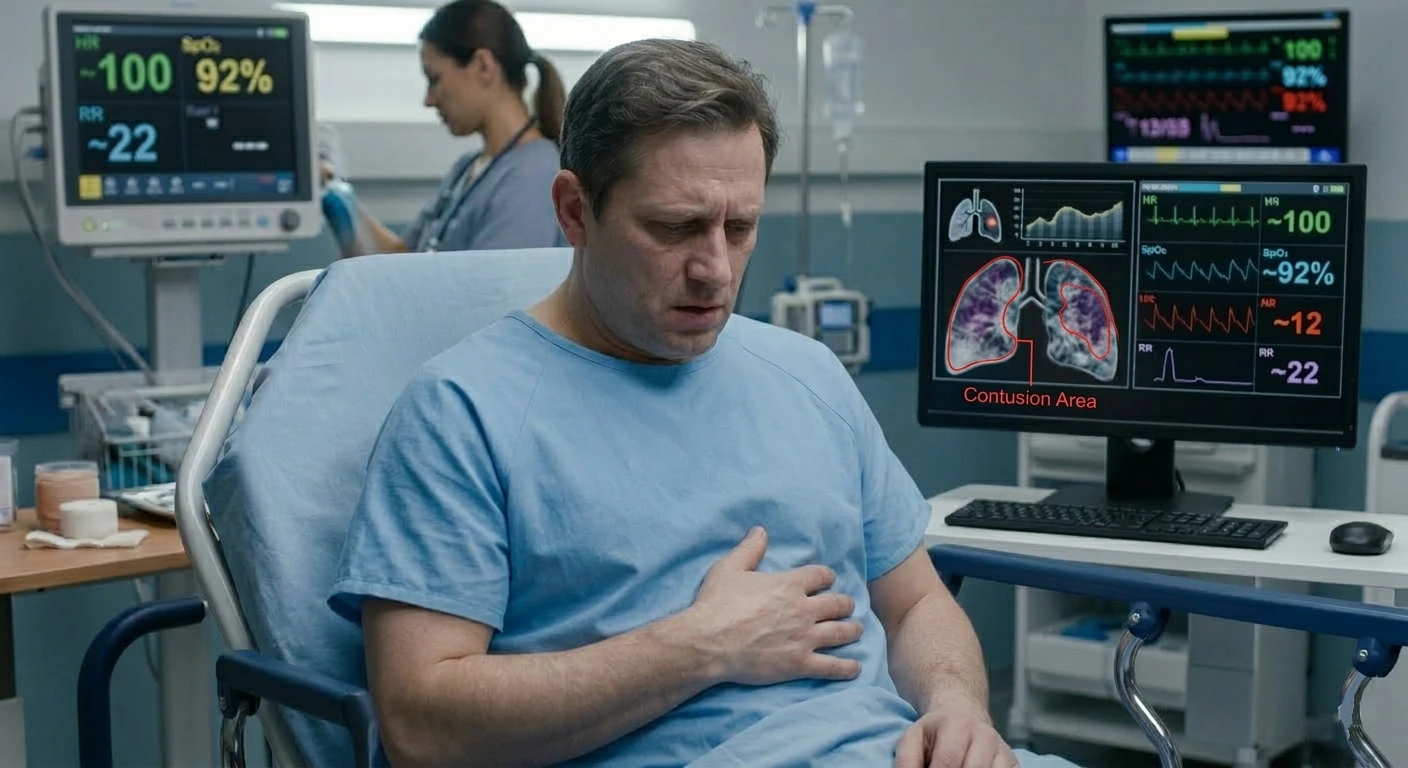
Lung contusion is a condition in which lung tissue is crushed as a result of a severe and blunt blow to the rib cage, bleeding and edema occur in the parenchyma.
In this injury, the outer membrane of the lung (pleura) or chest wall can preserve its integrity, but the shock waves created by the impact damage the air sacs called alveoli.
The filling of the air sacs with blood and fluid severely restricts the lung’s capacity to supply oxygen to the blood and poses a life-threatening risk.
This condition, which is usually seen after traumas such as traffic accidents or falling from a height, can follow an “insidious” course; Because the symptoms do not intensify immediately after the injury, but within the first 24-48 hours.
With modern thoracic surgery and intensive care protocols, patients with lung contusion can regain their health without permanent damage.
What is Lung Contusion? How is it formed?
Lung contusion, in its simplest terms, can be described as a “bruising” of the lung, but it is much more complex because this bruising takes place inside the vital organ.
With the force of the impact, the capillaries in the lung tissue crack and blood leaks into the alveoli; This creates a barrier that prevents gas exchange.
In addition, as a result of the body’s inflammatory response to this damage, fluid accumulation (edema) increases in the area, which causes the lung to harden and breathing becomes difficult.
Chest Traumas and Damage to Lung Tissue
Although the rib cage has a flexible structure, this energy is transmitted directly to the lung parenchyma during a sudden stop or severe impact.
Surface tension is disrupted in the damaged area and that part of the lung tends to deflate (atelectasis).
Since blood and edema fluid fill the spaces where air should enter, the oxygen level in the blood begins to decrease even if the patient breathes adequately.
Differences Between Lung Contusion and Lung Injury
Lung injury (laceration) refers to the cutting or rupture of lung tissue; Contusion is a crush in which tissue integrity is not impaired.
Injuries are often accompanied by lung collapse (pneumothorax) or accumulation of blood in the chest cavity (hemothorax).
Contusion, on the other hand, is a set of microscopic damage to the internal structure of the tissue and its treatment is based on supportive medical care rather than surgery.
What are the Symptoms of Lung Contusion?
Symptoms can range from a mild ache to severe respiratory failure, depending on the extent of the damage.
Chest Pain and Shortness of Breath (Dyspnea)
The most obvious complaint is chest pain that intensifies when breathing; This pain usually prevents the patient from breathing deeply.
As the amount of damaged tissue increases, the patient begins to breathe rapidly and superficially because the body cannot get the oxygen it needs.
Cough, Bloody Sputum and Bruising (Cyanosis)
The blood accumulated in the alveoli can be expelled with the cough reflex and cause pink-red blood in the patient’s sputum (hemoptysis).
In severe cases, bruising is observed on the lips, nail beds and fingertips due to lack of oxygen.
Factors Causing Lung Contusion
Lung contusion is a result of the high-energy traumas brought about by modern life.
Traffic Accidents and Falls from Heights
Blows to the chest from the seat belt or steering wheel in in-vehicle traffic accidents are the most common cause of lung contusion.
Even in falling from a height on your feet, the shaking energy can be transmitted upwards, causing crushing in the lungs.
Blunt Chest Trauma and Blast Injuries
Hard blows to the chest during sports injuries, battering, or work accidents are in the category of blunt trauma.
The pressure waves (blast effect) that occur at the time of the explosion can cause severe contusion by “exploding” the lung tissue from the inside, even though no external object hits the body.
Lung Contusion Diagnosis and Diagnostic Methods
Early diagnosis after trauma is critical to prevent the patient from entering respiratory failure.
Physical Examination and Listening to Breathing Sounds
When the physician listens to the lungs with a stethoscope, he may hear crackling-like sounds called “rales” in the contusion area.
The presence of bruising, tenderness or rib fracture in the chest wall strengthens the possibility that the underlying lung tissue is also crushed.
Chest X-ray and Computed Tomography (CT) Findings
Chest X-ray (X-ray) may appear normal immediately after the injury; This “early clean film” should not be misleading.
Computed Tomography (CT) is the most sensitive method for detecting contusion and clearly shows even the smallest damaged areas that X-rays cannot see.
Blood Gas Analysis and Oxygen Saturation Monitoring
The “Arterial Blood Gas”, which is examined with a sample taken from the blood, numerically shows how much the lung can clean the blood and the oxygen level.
With fingertip pulse oximeter monitoring, the patient’s oxygen status is monitored second by second.
Lung Contusion Treatment Methods
The main goal of treatment is to ensure that the patient receives adequate oxygen and prevent infection until the damaged area heals.
Oxygen Support and Respiratory Physiotherapy
In mild cases, it is sufficient to administer oxygen through a nasal cannula or mask; The patient is encouraged to practice deep breathing exercises (use of Triflo).
These exercises prevent the lung from deflating and help remove accumulated fluids.
Pain Management and Intercostal Nerve Blockade
The patient avoids breathing because he feels pain; This leads to lung collapse and pneumonia.
Therefore, effective pain relief is required; If necessary, the patient can breathe comfortably with nerve blockages between the ribs.
Fluid Restriction and Drug Treatments
Damaged lung tissue is a “wet” tissue; Excess fluid given to the body intravenously can increase edema in the lungs.
For this reason, the fluid balance is adjusted very precisely and drugs can be used to reduce inflammation in the lungs.
Approach Table According to Lung Contusion Severity
| Damage Rating | Symptoms | Treatment Method |
| Lightweight | Mild pain, normal oxygen | Observation, Pain relief, Breathing exercise |
| Medium | Marked shortness of breath, cough | Hospitalization, Oxygen support, Physiotherapy |
| Heavy | Severe bruising, low oxygen | Intensive care, Ventilator (Respirator) support |
Prof. Dr. Levent Alpay: Lung contusion is a condition that requires “timing” in thoracic surgery. Even if everything seems fine at the first examination, we keep these patients under observation for at least 24-48 hours; Because fluid accumulation in the lungs increases over time. Our biggest mistake is underestimating pain; If you do not relieve the patient’s pain, he cannot breathe deeply and a simple crush can turn into a severe pneumonia within 3 days. Proper pain control and early physiotherapy are the cornerstone of this treatment.
Case Experience (Anonymous):
The 35-year-old patient, who hit his chest on the steering wheel after a traffic accident, had only mild pain when he applied to the emergency room. Chest X-ray was normal, but CT showed a 30% contusion in the right lung. The oxygen level of the hospitalized patient started to decrease after 12 hours. The patient, whose lungs were completely opened on the 4th day with intense oxygen and aggressive respiratory physiotherapy, was discharged without the need for surgery.
If you have suffered a blow to your chest area and are experiencing shortness of breath or pain, you can make an appointment with our clinic for a detailed check-up and seek expert opinion before there is a life-threatening risk.
Potential Complications and Risk Management
If lung contusions are not managed properly, they can lead to secondary problems.
Pneumonia and ARDS Risk
The blood and fluid in the crushed area is an ideal breeding ground for bacteria; Therefore, the risk of developing pneumonia after contusion is high.
In contusions involving very large areas, the lungs may fail completely (ARDS) and the patient may need to be connected to a ventilator for a long time.
Recovery Time for Lung Contusion
Mild contusions usually heal on their own within 3-7 days, while in severe cases, it may take weeks for the lung to be cleared radiologically.
There is usually no permanent damage after healing, but smoking significantly prolongs the healing process.
Frequently Asked Questions
Does Lung Contusion Go Away on Its Own?
Yes, the body cleans the blood and fluid in the damaged area over time; However, it is vital to seek medical help during this process, such as oxygen support and pain control.
Is Lung Crush Life-Threatening?
It can be life-threatening due to respiratory failure, especially in the elderly, those with comorbidities, or extensive contusions affecting more than 20% of the lung.
When Do Lung Crush Symptoms Appear?
It usually begins immediately after the trauma but is most severe between 24 and 48 hours; Therefore, close follow-up is required for the first two days after trauma.
Scientific Bibliography
- StatPearls (NCBI): Pulmonary Contusion Management and Pathophysiology
- Journal of Thoracic Disease (2019): Pulmonary contusion – Rendeki S et al.
- MSD Manuals: Thoracic Trauma: Pulmonary Contusion Professional Version
- Journal of Thoracic Disease: Imaging of Blunt Chest Trauma