 EN
EN




Ingredients
- What is Stage 2 Lung Cancer?
- Stage 2 Lung Cancer Characteristics and Grouping (IIA and IIB)
- What Does Tumor Size and Lymph Node Spread (N1) Mean?
- What are the Symptoms of Lung Cancer Stage 2?
- Clinical Findings Indicating Disease Progression
- Chest Pain and Respiratory Distress
- Lung Cancer Stage 2 Treatment
- Lung Cancer 2. Stage Surgery
- Closed Method (VATS) and Robotic Surgery Options
- Postoperative Preventive Treatment: Adjuvant Chemotherapy and Radiotherapy
- Lung Cancer Stage 2 Life Expectancy and Success Rates
- Factors Affecting Post-Treatment Survival Rates
- The Impact of Early Intervention on Quality of Life
- Frequently Asked Questions
- Scientific Bibliography
Staging lung cancer is vital for understanding the spread of the disease in the body and determining the most appropriate treatment strategy.
Stage 2 Lung Cancer is a stage where the tumor increases in size in the lung or begins to reach the lymph nodes in the immediate vicinity.
This stage represents a process where the chance of surgical intervention is still high and successful results can be obtained with multimodality treatments.
Thanks to the developing thoracic surgery techniques today, there are treatment methods that maintain the quality of life for patients at this stage.
What is Stage 2 Lung Cancer?
Lung cancer 2 stages are defined according to the relationship of the tumor with the surrounding tissues and regional lymph node involvement.
At this stage, the cancer has not yet spread to distant organs (such as brain, bone, liver).
However, it requires more careful treatment planning compared to the first stage and often additional treatments that support surgery.
Stage 2 Lung Cancer Characteristics and Grouping (IIA and IIB)
The second stage is divided into two subgroups as IIA and IIB.
In the IIA stage, the tumor is usually between 4-5 cm and there is no lymph node involvement.
In the IIB group of second-stage lung cancer cases, the tumor size may be larger or there may be spread to the lymph nodes (hilar lymph nodes) on the same side of the lung.
What Does Tumor Size and Lymph Node Spread (N1) Mean?
Lymph node spread, called “N1” in medical terminology, indicates that the cancer has reached the lymph nodes around the main bronchi of the lung.
This indicates that the disease is a little more active locally, but is still within the limits of surgery.
What are the Symptoms of Lung Cancer Stage 2?
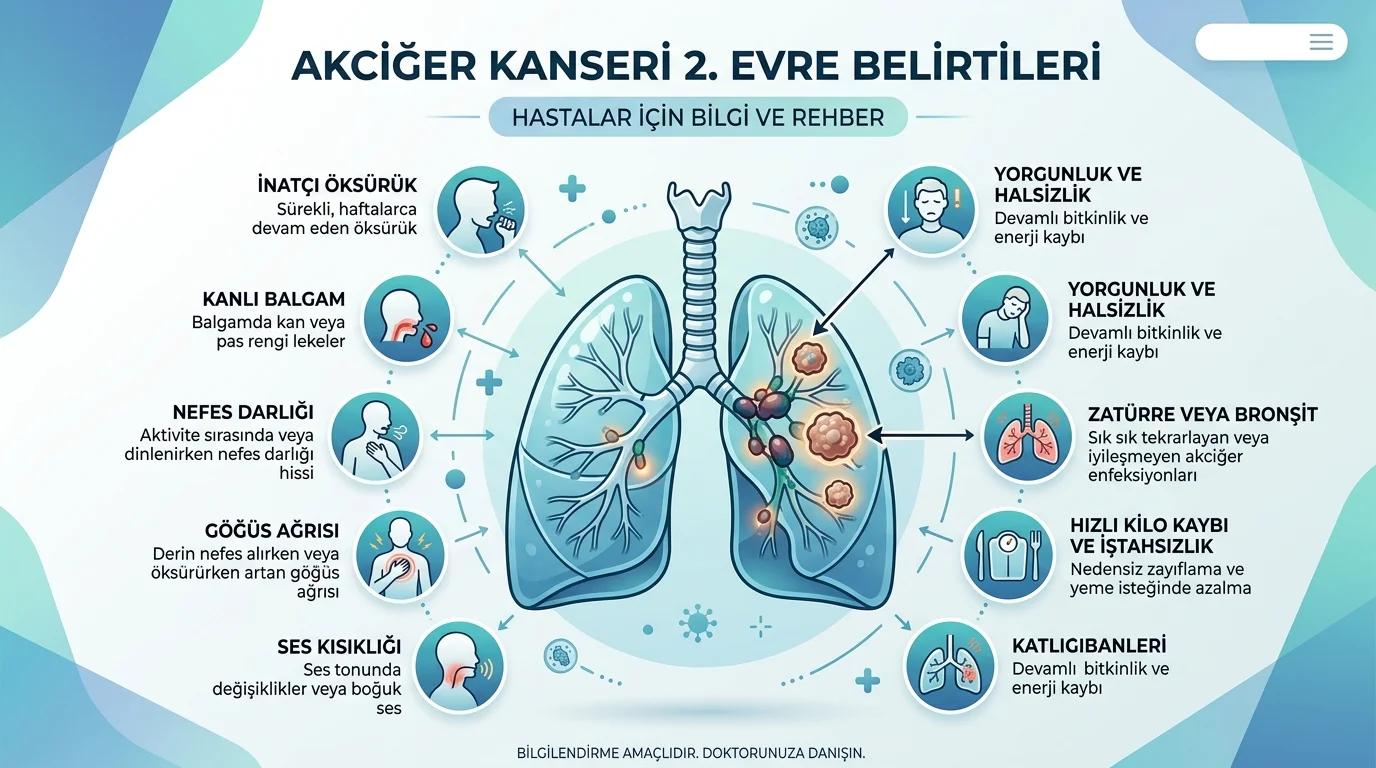
Compared to the first stage, symptoms may become a little more pronounced at this stage.
Lung cancer stage 2 symptoms vary depending on the proximity of the tumor to the airways or chest wall.
Clinical Findings Indicating Disease Progression
- Persistent and increasing coughing fits.
- Blood in the sputum or pink secretion.
- Persistent fatigue and mild weight loss.
- Pain sensation fixed at a certain point of the rib cage.
Chest Pain and Respiratory Distress
With the growth of the tumor, a decrease in lung capacity may occur.
This increases the complaints of wheezing and shortness of breath that occur during exertion.
Lung Cancer Stage 2 Treatment
In the second stage, the main goal is to surgically remove the tumor and minimize the risk of recurrence.
Lung cancer 2 stage treatment consists of a combination of surgery, chemotherapy and sometimes radiotherapy.
Lung Cancer 2. Stage Surgery
Surgery is the first option in patients with suitable cardiovascular and respiratory capacity.
The lung cancer stage 2 surgery process usually involves the removal of the tumorous lobe (lobectomy) and surrounding lymph nodes (lymph node dissection).
Closed Method (VATS) and Robotic Surgery Options
In modern surgery, closed methods without completely opening the rib cage are at the forefront.
These methods allow the patient to feel less pain and return to social life faster.
Treatment Approaches Comparison Table
| Feature | Surgery Only | Surgery + Adjuvant Treatment |
| Application Area | Very limited low-risk cases | Most of them are stage 2 patients |
| Risk of Recurrence | Relatively higher | At a lower level |
| Healing Process | 1-2 weeks (physical) | Variable depending on treatment cycles |
| Purpose | Local tumor control | Both local and systemic control |
Postoperative Preventive Treatment: Adjuvant Chemotherapy and Radiotherapy
In the case of lymph node involvement in the second stage, it is a medical standard to give chemotherapy after surgery.
This “protective” treatment aims to clear microscopic cells that may have become entangled in the bloodstream.
Prof. Dr. Levent Alpay: Spread to the lymph nodes in the second stage does not mean that the treatment is over; on the contrary, it indicates the beginning of a more disciplined treatment process. Smart drugs or immunotherapies applied after surgery significantly increase the chance of success today. The most critical step is for my patients to keep their morale high in this process and to continue on their way with a multidisciplinary oncology team.
Lung Cancer Stage 2 Life Expectancy and Success Rates
Many patients and their relatives focus on post-diagnosis statistics.
Lung cancer stage 2 life expectancy is shaped by the success of the surgery and the response to additional treatments.
Factors Affecting Post-Treatment Survival Rates
In the light of current data, the chance of surviving stage 2 lung cancer is around 50-60% on a five-year survival basis.
However, it should be remembered that these figures are general statistics and personal factors (age, comorbidities, genetic structure of the tumor) can change the process.
The Impact of Early Intervention on Quality of Life
Early initiation of treatment and complete removal of the tumor (R0 resection) allows the patient to live healthy for many years.
The life expectancy of patients diagnosed with stage 2 lung cancer is increasing every year with modern follow-up protocols.
Clinical Experience and Case Example (Anonymous)
A 62-year-old patient with stage IIB with hilar lymph node involvement underwent closed (VATS) lobectomy.
Our patient, who received 4 cycles of preventive chemotherapy after surgery, did not find any signs of disease in the 3rd year of follow-up.
Frequently Asked Questions
What does stage 2 mean in cancer?
In cancer, stage 2 describes the locally advanced stage, where the tumor has grown slightly larger than its starting point and has often spread to nearby lymph nodes but has not yet spread to distant organs.
Can stage 2 lung cancer be cured?
Yes, lung cancer stage 2 treatment is carried out with a multidisciplinary approach; Basically, surgical intervention aims to remove the tumor, while supportive methods such as chemotherapy before or after the operation are also included in the process.
Can stage 2 lung cancer be cured?
In cancer cases at this stage, there is a strong possibility that the disease can be completely controlled and a full recovery can be achieved thanks to a successful surgical operation followed by preventive treatments.
Is stage 2 cancer dangerous?
Although every cancer stage carries risks if left untreated, stage 2 is at a very critical and advantageous point for medical intervention because the disease is still within the limits of surgery and has not metastasized.
Scientific Bibliography
- The Journal of Clinical Oncology (ASCO): Adjuvant Chemotherapy in Stage II NSCLC
- PubMed Central (PMC): Surgical outcomes and survival in Stage II lung cancer
- IASLC Thoracic Oncology: TNM Classification 8th Edition – Clinical Implications
- New England Journal of Medicine: Postoperative therapies for resectable lung cancer