 EN
EN




Ingredients
- Lung Cancer 1. What is Phase?
- Stage 1 Lung Cancer Characteristics (TNM Classification)
- Differences Between IA and IB Phases
- Symptoms of Stage 1 Lung Cancer
- Insidious Symptoms That Appear at an Early Stage
- Stage 1 lung cancer symptoms and diagnosis
- Lung Cancer 1. Stage Treatment Methods
- Lung Cancer Surgery and Surgical Options
- Closed Surgery Method: VATS and Its Advantages
- Is Chemotherapy and Radiotherapy Required After Surgery?
- Lung Cancer 1. Stage Life Expectancy and Success Rates
- Lung Cancer Survival Rate: The Importance of Early Detection
- Post-Treatment Recovery Process and Follow-up Protocol
- Scientific Bibliography
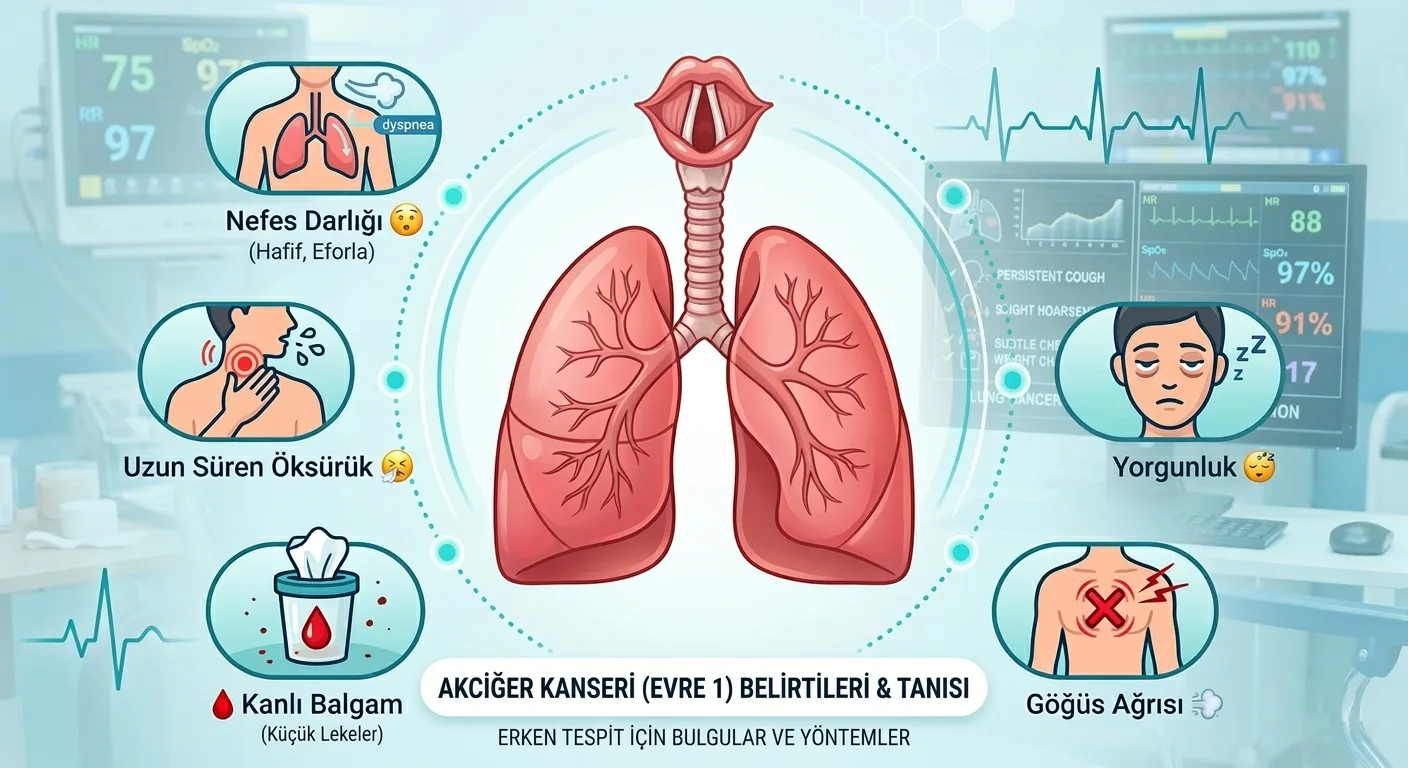
Lung cancer stage 1 symptoms include:
Persistent cough
· Chest pain
· Mild shortness of breath
· Wheezing
Recurrent infections
Hoarseness
Weakness and fatigue
· Loss of Appetite
For patients diagnosed with lung cancer, staging is the most critical step in the treatment plan.
Lung cancer stage 1 refers to the stage where the tumor is confined only to the lung tissue and has not yet spread to lymph nodes or distant organs.
This stage is defined as the “early stage” in the medical literature and has the highest success rates when intervened.
Current surgical technologies and advances in molecular oncology offer a promising recovery process for patients at this stage.
Lung Cancer 1. What is Phase?
Stage 1 lung cancer is divided into subgroups according to the diameter of the tumor and its location in the lung.
According to the international classification of TNM, at this stage the tumor has not yet made a serious attack on the outer membrane of the lung or the main bronchi.
Stage 1 Lung Cancer Characteristics (TNM Classification)
At this stage, the tumor is usually less than 4 centimeters in size.
Lymph node involvement (N0) and distant metastasis (M0) are not seen.
Medically, this indicates that the disease remains localized and has a good chance of being completely cleared surgically.
Differences Between IA and IB Phases
- Stage IA: The tumor is 3 cm or smaller. There is no pleural involvement.
- Stage IB: The tumor is between 3-4 cm or has started to show proximity to the main bronchi and membrane of the lung.
Symptoms of Stage 1 Lung Cancer
Early-stage cancers usually progress insidiously and occur incidentally on screening.
However, lung cancer stage 1 symptoms can sometimes manifest themselves with mild signals given by the body.
Insidious Symptoms That Appear at an Early Stage
- Mild cough that lasts for weeks and the cause cannot be explained.
- Stinging sensation felt in the rib cage when breathing deeply.
- Slight shortness of breath noticed when exerting.
- Recurrent and delayed healing lung infections.
Stage 1 lung cancer symptoms and diagnosis
Most patients are diagnosed with stage 1 lung cancer with an x-ray or tomography taken during a check-up.
Diagnosis made before symptoms become evident increases the success of treatment exponentially.
Lung Cancer 1. Stage Treatment Methods
In the early stage, the main strategy is to completely remove the tumor tissue from the body.
Lung cancer stage 1 treatment is planned according to the patient’s general health condition and respiratory capacity.
Lung Cancer Surgery and Surgical Options
Lung cancer stage 1 surgery process is performed with tissue-sparing methods today.
The surgeon removes the cancer by removing the lobe with the tumor (lobectomy) or a smaller piece (segmentectomy).
Closed Surgery Method: VATS and Its Advantages
VATS (Video-Assisted Thoracoscopic Surgery) is a closed surgical method performed through small incisions.
It provides less pain and faster recovery compared to traditional open surgeries.
Comparison of Surgical Methods
| Feature | Open Surgery (Thoracotomy) | Closed Surgery (VATS) |
| Incision Size | 15-20 cm | 2-3 cm |
| Hospital Stay | 5-7 days | 2-3 days |
| Recovery Time | 4-6 weeks | 1-2 weeks |
| Pain Level | Medium/High | Low |
Is Chemotherapy and Radiotherapy Required After Surgery?
In stage 1 cases of lung cancer , no additional systemic treatment is usually needed after surgery.
However, if the tumor size is close to 4 cm or if some risk factors are present, preventive (adjuvant) treatments may be considered.
Prof. Dr. Levent Alpay: The biggest advantage of our patients diagnosed at an early stage is that the disease has not yet spread. At this stage, surgery is the gold standard of treatment. Instead of fearing surgery, it is vital to focus on the chance of a “full cure” provided by comfortable methods such as closed surgery.
Lung Cancer 1. Stage Life Expectancy and Success Rates
The life expectancy of stage 1 lung cancer, which is the subject that patients are most curious about, is very promising with early intervention.
Lung Cancer Survival Rate: The Importance of Early Detection
In terms of five-year survival rates, lung cancer stage 1 survival can be up to 80% to 90%.
This rate is much higher than all other stages of cancer.
Post-Treatment Recovery Process and Follow-up Protocol
After the treatment of stage 1 lung cancer is completed, the patient is followed up regularly.
Controls made every 3-6 months during the first two years ensure that possible recurrences are caught early.
Clinical Experience and Case Example (Anonymous):
Our 52-year-old patient, who had a 1.5 cm lesion in his lung during the check-up, was diagnosed with stage IA.
Segmentectomy operation was performed with the closed method (VATS).
Our patient, who was discharged on the 2nd day after the surgery, continues his routine check-ups in the 4th year and is completely healthy.
You can learn about modern treatment options by making an appointment at our clinic.
Scientific Bibliography
- The Lancet (2022): Segmentectomy versus lobectomy in small-sized peripheral non-small-cell lung cancer (JCOG0802/WJOG4607L): a multicentre, open-label, phase 3, randomised, controlled, non-inferiority trial – Saji H et al.
- National Comprehensive Cancer Network (NCCN): Guidelines for Patients: Lung Cancer Early Stage
- PubMed: VATS vs. Open Lobectomy for Early-Stage Lung Cancer
- New England Journal of Medicine (2011): Reduced lung-cancer mortality with low-dose computed tomographic screening – National Lung Screening Trial Research Team